Music vanishes the moment it happens. That’s the fundamental problem humans have faced for millennia. We crave permanence. We want to hold onto the fleeting. Early attempts to solve this split into two paths: symbols and signals. Musical notation is the symbol system. It matures first. It monopolizes music recording for centuries. A trained musician reads the symbols. They interpret them. They turn ink into sound.
Signals are different. They are direct physical impressions. They bypass the performer entirely. Some modern electronic compositions even skip the recording step, generating sound directly from code. This article focuses on the nonsymbolic method. The physical capture. The signal.
Three Paths to Reproduction
Physical reproduction falls into three buckets. Mechanical. Acoustical. Electrical. The mechanical method uses automatic instruments. Think barrel organs. The designer programs the mechanism. The machine plays itself. The sound belongs to the apparatus, not a human.
Acoustical and electrical methods are closer to what we recognize today. They capture sonic vibrations. They reproduce them. The difference? The acoustical method uses purely mechanical means. The electrical method uses vacuum tubes, transistors, and other electronic devices. Both aim to reproduce an independent performance. The intent is fidelity to the moment.
Until the late 19th century, mechanical reproduction ruled. Reports exist of wind-based methods dating to 1500 BCE in ancient Egypt. A colossal statue of the god Memnon at Thebes made sounds to greet his mother, the dawn goddess. An earthquake toppled it in 27 CE. Reconstruction killed the ability. The sound stayed gone.
Early Mechanical Experiments
Medieval Friar Roger Bacon reportedly invented a talking head. Josef Faber in Vienna created a talking man in 1860. It used ivory reeds for vocal cords. A rubber tongue and lips. A keyboard controlled the mouth cavity to shape words. Common techniques relied on human hands or clockwork. A cylinder embedded with pins struck metal teeth. Or operated pipes. Or triggered bell clappers.
Automatic carillons appear in the 1300s. Harpsichords and organs follow in the 1500s. King Henry VIII of England owned an automatic virginal. Queen Elizabeth I sent the Sultan of Turkey an elaborate musical clock in 1593. It played every six hours. Sixteen chimes sounded first. Two trumpets followed. Then an organ tune. Finally, a “holly bushe full of birds and thrushes” sang and shook their wings. Queen Victoria owned a bustle that played “God Save the Queen” when she sat down.
The most common technique required a human hand or clockwork to turn a cylinder embedded with pins.
Illustrious composers wrote for these machines. Joseph Haydn wrote tunes for pipe organ clocks. Mozart composed several pieces for mechanical organs. Beethoven wrote Wellington’s Victory (or the Battle Symphony ) for the panharmonicon. Johann Nepomuk Maelzel, a German musician who perfected the metronome, invented this full mechanical orchestra.
The End of the Pin and Barrel
Two inventions superseded the barrel-and-pin mechanism at the end of the 19th century. The player piano came first. It used perforated cardboard rolls. These controlled a stream of air. The air activated the piano’s hammers. This allowed pianists to record performances. Virtuosos took advantage. Ignacy Paderewski. Edvard Grieg. Claude Debussy. Sergey Rachmaninoff.
Some composers, including Igor Stravinsky and Paul Hindemith, wrote music specifically for piano rolls. They used devices capable of playing up to 30 notes simultaneously. Impossible for two human hands. Easy for perforated paper.
The second invention obliterated the rest. The phonograph. It made all previous apparatuses obsolete. Except in toys and cuckoo clocks.
By 1967, the shift in power within the music industry was undeniable. A survey of hundreds of American composers revealed a stark truth: they cared far more about recordings than printed scores or live performances. This wasn’t just a preference. It was a structural change. Through records, composers finally gained easy access to the music of their peers and a permanent, high-fidelity medium for their own creations.
Milton Babbitt, a towering figure in contemporary American composition and teaching, captured this shift during a 1965 conversation with pianist Glenn Gould. Gould, who built his reputation almost entirely on broadcasts and records rather than stage appearances, highlighted the unprecedented influence of the medium.
We have all been affected as composers, as teachers, as musicians by recordings to an extent that cannot possibly be calculated as yet.… I don’t think one can possibly exaggerate the extent to which the climate of music today is determined by the fact that the total Webern is available on records, that the total Schoenberg is becoming available.
Babbitt’s point was simple but profound. The total works of avant-garde pioneers like Anton Webern and Arnold Schoenberg were no longer locked away in rare manuscripts or difficult-to-find live performances. They were sitting on shelves, accessible to anyone with a turntable. This accessibility fundamentally altered the musical climate.
The Early Years of Recorded Sound
The use of the record as a creative medium didn’t start with electronica. It began with superficial experiments. In 1904, Ruggero Leoncavallo wrote the song “Mattinata” specifically for the phonograph label. He designed the piece to suit the limitations of early recording technology.
By 1925, Igor Stravinsky took a step further. He composed Serenade in A Major expressly for the record medium. While it can be performed live today, its initial conception was tied to the mechanical reproduction of sound.
Then came the true integration of recorded sound into composition. Ottoriano Respighi’s Pines of Rome (1924) famously included a recording of a nightingale’s song in its third movement. This wasn’t just an effect. It was a fundamental blend of acoustic performance and technological capture.
The mid-century saw this evolve into something far more significant. Composers like Edgard Varèse and Morton Subotnick began creating works that only existed as recorded tape.
- Varèse’s Poème électronique : An 11-channel tape played through 425 speakers at the 1958 Brussels World Fair.
- Subotnick’s Silver Apples of the Moon (1967) : An electronic work that could not be performed live in its original form. It existed only as a recording.
These works proved that the recording medium was no longer just a document of a performance. It was the performance itself.
Teaching with the Phonograph
In music education, the phonograph quickly became indispensable. Teachers who lacked the skill or resources to demonstrate complex pieces at the piano used records to illustrate musical examples. The technology allowed educators to bring entire orchestras into small classrooms without hiring musicians.
This transformed how students learned music history.
In 130, the Columbia History of Music by Ear and Eye became a staple in music history classes. This phonographic survey allowed students and teachers to hear instruments that were largely extinct or obscure in their daily lives: viols, lutes, virginals, clavichords, and harpsichords. They could hear the actual music written for them, rather than just reading about it.
A few years later, L’Anthologie sonore added further depth to this specialized field. By the 1960s, the trend accelerated. Baroque music from the 17th and 18th centuries, along with Renaissance and Medieval pieces, were increasingly recorded using the original instruments.
This created a wide audience beyond academia. The phonograph didn’t just teach students. It revived interest in historical performance practices.
By the late 20th century, this educational influence had grown. Many conservatories, colleges, universities, and even some secondary schools built their own recording studios. Students could now analyze their own performances or rehear their compositions with precision. This self-reflection became a standard part of music training.
The Concert Hall in the Shadow of the Record
The impact of recordings on live performance was enormous. Both classical and popular musicians faced a new reality: you could not survive as a performer without a distinguished recording catalog.
Audiences, both domestic and international, often knew the performers through records before they ever stepped into a concert hall. In popular music, this gap between live and recorded ability widened. Many performers relied heavily on technical aids in the studio. Their live appearances could not compete with the polished, layered sound of their records.
Some critics feared this would lead to the demise of the live concert. They argued that if the concert hall survived at all, it would do so for social reasons rather than musical ones. People would go to concerts for the experience, not the sound quality.
There was a visible indicator of this shift in publishing. Independent, non-academic, non-professional classical music magazines disappeared in America. They were replaced by record magazines.
The name changes tell the story:
– The American Record Guide (originally The American Music Lover, 1935)
– High Fidelity (established 1951)
– Stereo Review (established 1958 as Hi Fi/Music Review )
This wasn’t just an American phenomenon. The shift toward recording-focused media happened globally.
- England : The Gramophone and Records and Recording
- France : Diapason and Harmonie
- Germany : HiFi Stereophonie and Fono Forum
- Italy : Discoteca Hi Fi
- Holland : Luister
- Belgium : Hi-Fi Musique
- Sweden : Musikrevy
- Japan : Record Art/Record Geijutsu
These periodicals shifted focus from live criticism to recording evaluation.
Musicology and the Tape Recorder
The entire field of comparative musicology depends on disc and tape recordings. This field studies the relationships between Western and non-Western music. While its roots trace back to the 18th century, the discipline was fundamentally transformed by phonographic tools.
Many non-Western musical traditions are transmitted orally. They lack a written tradition. This means their performance practices—especially rhythm and intonation—cannot be accurately transcribed into Western notation. A score cannot capture the nuance of a microtonal scale or a complex rhythmic cycle if the culture doesn’t write it down.
After World War II, this gap became urgent. Anthropologists and musicologists traveled to the most remote parts of the world. They carried tape machines to record aboriginal music before it was tainted or wiped out by Western civilization.
The recording became the only reliable archive. Without it, these musical traditions might have vanished or been misrepresented. The tape recorder didn’t just document music. It preserved cultures.
The question remains: if the recording can preserve the nuance better than a score, what is the role of the live performer today? The answer isn’t clear. The technology has already changed the game. The rest is just playing catch-up.
In the world of popular music, the producer isn’t just a collaborator. They are often the architect. While classical recordings sometimes treat the producer as an equal partner with the musicians, pop records view the raw sounds as mere material to be molded.
The producer works with artificial sounds. They layer sound upon sound. They add electronic reverberation. They create multichannel effects where instruments seem to move around the listener.
It is a paradox of modern music. Technology allowed recordings to move beyond mimicking live performances. But then, musicians began bringing complex electronic gear into concert halls just to recreate those impossible recording sounds in real life.
The Myth of Live Perfection
In classical music, the initial goal was simple. Should the recording capture what you hear from the best seat in the house? Or should it enhance the performance?
Eventually, correcting mistakes became standard. Magnetic tape made editing easy. If a section had problems, the orchestra would play it again. The best take was spliced into the master tape.
“Tape editing facilitated the excision of poor passages… but it also has been said to have hampered the continuity of the performance.”
This created a new expectation. Audiences began expecting live concerts to match the flawless precision of recorded albums. Even during a live concert, performers might return to the studio later to fix blemishes.
The continuity issue was worse back when music had to be recorded in five-minute segments. Those 78 rpm discs limited how much you could capture at once. Today, most listeners can’t spot the rare movement that wasn’t spliced. But the illusion of perfection remains.
Close-Miking vs. Natural Sound
Microphone placement defines the style of large-scale classical recordings. The split is between “natural” and “creative” techniques.
Natural setups place microphones in optimum hall positions. Often, they sit directly over the conductor. The goal is to re-create the concert hall effect. The conductor is responsible for balancing the instrumental and vocal sounds.
Close-miking is different. Companies prefer putting microphones closer to the performers. The producer, often with the conductor’s approval, controls the balance. They bring out specific lines. This is participation in the interpretation.
Studio-made popular recordings generally use close-miking. In some cases, every performer in a small group gets their own microphone.
A close-miked symphonic session is loud with wires. You might see:
* Three microphones for violins
* One for cellos and basses (sometimes separate)
* One each for woodwinds and brasses
* Separate mics for timpani, snare drum, triangle, bass drum, cymbals
* Microphones for celesta or harp
* One for the soloist
* Three to six microphones for a chorus
The Evolution of Multitrack Recording
Producers balance the strength of these inputs during the session. They make several separate recordings, or “tracks,” at the same time.
Until about 1960, two-track machines were the norm. By 1970, eight-track recorders were in use. This allowed for much subtler mixing during editing sessions. Popular music sessions sometimes used 16-track recorders.
For stereophony, all tracks were edited and mixed down to two channels. The producer decided the separation between those channels. In dramatic recordings like opera, they might even act as a stage director, guiding performers around the “aural stage.”
The Quadraphonic Failure
Quadraphony introduced four channels. It tried to find a market in the early 1970s. It failed.
The debate between natural and close-miked recording persisted in this format. In classical music, the rear channels were often used for hall ambience. Arguments centered on the front channels.
Some companies used all four channels as equal partners. Columbia placed the conductor in the middle of the orchestra. They seated the group for an optimum quadraphonic array, not for the best concert-hall effect.
Several systems competed for dominance:
* Columbia’s SQ
* Japan Victor Company’s CD-4 (RCA’s Quadradisc in the US)
* Sansui’s RM (also called QS)
These systems were incompatible. Consumers were confused. They waited for one to become the standard. They withheld their votes from all of them.
By the end of the decade, the aural and aesthetic benefits of quadraphony had all but disappeared from the marketplace.
From novelty to high art
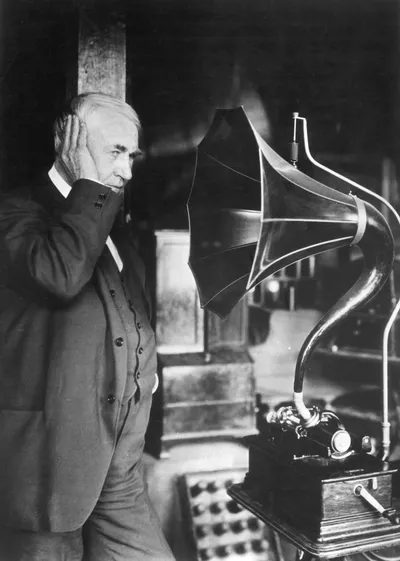
Thomas Edison didn’t just invent a machine. He captured a ghost. In 1877, he heard “Mary had a little lamb” replayed from a wax cylinder. It was the first time human voice had been reproduced. The phonograph was born.
Edison didn’t wait. He sent reps and cylinders to Europe almost immediately. By 1888, the recordings were accumulating. Alfred, Lord Tennyson. Robert Browning. Johannes Brahms played a Hungarian rhapsody. But the first true celebrity cut? Josef Hofmann. A 12-year-old piano prodigy visited Edison’s West Orange, New Jersey, lab in 1888. Hans von Bülow followed, recording a Chopin mazurka.
Then the format war began.
Charles and Émile Pathé built a small factory in a Paris suburb in 1894. They recorded singers like Mary Garden. Their catalog hit 12,000 items within a decade. In Europe, their name became synonymous with the cylinder.
Meanwhile, in Washington, D.C., Emile Berliner filed a patent for a different beast: the gramophone. It used a disc. Not a cylinder. A flat, manageable disc. Berliner started manufacturing these in 1894. The advantage? Manufacturing ease. Discs were cheaper to press than cylinders.
Berliner’s network expanded fast. A branch in London became the Gramophone Company in 1898. Berlin got Deutsche Grammophon AG. France got the Compagnie Français du Gramophone. His brother set up a pressing plant in Hannover, Germany.
Europe’s recording industry was largely built by Berliner’s representatives.
In the U.S., this small Berliner outfit grew into the giant Victor company. By the early 20th century, Germany, Austria, Russia, and Spain had established their own industries. They imported managers and tech from America. The table turned by 1970, with Europe commanding most of the American market. But that’s a future problem.
In the 1890s, phonographs were dime-store novelties. Coin-in-the-slot machines in public halls. People didn’t care about the talent. They cared about the magic of the box. Whistlers. Bands. Comic ditties.
Then culture shifted.
Victor and its affiliates raised the bar. They launched the Red Seal series (called Red Label in Europe). The catalyst was Enrico Caruso. Starting in 1902, Victor recorded his discs in Milan. Caruso’s voice transformed the phonograph from an amusing gadget into a respected cultural pillar. By 1910, classical music accounted for up to 85% of record sales. It wasn’t just background noise anymore. It was high art.
The Red Label had started in Russia in 1901. Fyodor Chaliapin was among the first artists to record on those new 10-inch discs.
In 1902, Victor and Columbia pooled their patents. A strategic move. It allowed Victor to record on wax and electroplate it for the first time. Caruso’s Milan sessions used this new wax process.
That same year, London-made recordings joined the Red Label. Stars from Covent Garden. Landon Ronald, a serious conductor and music director for the Gramophone Company, convinced his colleagues that the gramophone had musical merit. He brought in violinist Jan Kubelík, one of the few instrumentalists in the early serious series.
Columbia followed suit in the U.S. in 1903. They issued 10-inch Grand Opera Records featuring Metropolitan Opera stars. Victor began its own celebrity sessions. 31/2-minute 12-inch discs. They also imported European Red Label cuts to the U.S. Mary Garden singing Debussy, with the composer at the piano, became available here.
Columbia dropped its opera series quickly. Songs and marches sold better. Victor didn’t. They saw institutional value in prestige.
The Red Seal influence bled into everything. “Victrola” became a generic term for disc phonographs in the public mind. Victor practically monopolized the quality market. The entire Western Hemisphere record market was split between Victor and Columbia. Their London affiliates controlled the rest of the world.
This duopoly held until World War I. Ties with Deutsche Grammophon were severed. DGG emerged as an independent entity after the war.
Between 1907 and 1910, Columbia tried to catch Victor’s cultural prominence. They released records from Europe. They reinstated operatic sessions. They started double-sided discs, a format already common in Europe. Victor didn’t adopt double-sided pressing until 1923. Too late to lead, but still ahead.
The machine kept getting better. The sound stayed cold.
The acoustic era: before microphones took over
Early recording sessions were a physical exercise in proximity. You didn’t just step into a booth. You had to cram yourself into a funnel. Both cylinder and disc formats relied on purely acoustic methods long after electronic amplification existed elsewhere. A singer stood in front of a massive horn. Their voice traveled through the air and vibrated a diaphragm. That diaphragm cut directly into the wax surface.
Accompanists faced the same spatial constraints. Pianists sat on raised platforms. The back of the piano was often removed entirely. This exposed the soundboard and strings so they faced the recording horn alongside the vocalist. It wasn’t a subtle arrangement. It was brute force acoustics.
Small orchestras eventually became viable for these sessions. A sound box was attached to violins and violas. This amplified their output enough to reach the horn. But the low end remained a problem. Bassoons doubled the cello parts. Tubas covered the double bass lines. The equipment simply couldn’t capture the depth of string instruments.
This limitation made certain achievements historic. When Josef Kubelík recorded in 1904, newspapers in London took notice. He didn’t use a violin equipped with an amplifying sound box. He played his own Stradivarius. The sheer audacity of using an unmodified, high-quality instrument in an acoustic process was rare. Most musicians had to compromise their sound to be recorded at all.
Symphonic recordings suffered similar distortions. Wind and brass instruments often doubled the lower string parts. Cello lines were frequently covered by bassoons. Double bass parts were sometimes handled by tubas. The goal was frequency coverage, not accuracy. The original string writing was lost in the mix.
Acoustical techniques improved throughout the 1920s. Engineers got better at positioning musicians. They refined the horns. They understood resonance better. But the fundamental physics remained a barrier. You couldn’t force a horn to capture frequencies it wasn’t built for.
The real shift didn’t happen until microphones arrived. Electrical recording processes emerged around 1925. Suddenly, signal amplification replaced physical vibration. The problems of acoustical limitations didn’t just improve. They vanished.
How the phonograph became a mass medium
Between 1910 and 1920, the phonograph stopped being a parlor trick and turned into a genuine mass medium. Classical recordings of full orchestras started appearing alongside pop hits. It wasn’t just about the technology, though. The explosion of popular music, specifically ragtime, drove the sales. Scott Joplin’s rags had set the stage earlier, but Irving Berlin’s Alexander’s Ragtime Band (1910) truly set the country on fire in 1911.
This wasn’t just listening. It was a dance craze. Millions of people who had never danced before suddenly wanted to. They needed machines to keep time. The result was staggering. Phonograph sales jumped fivefold between 1914 and 1919. New buyers purchased their first records.
Jazz arrived early but slowly. Victor issued the first jazz recordings in 1917 with the Original Dixieland Jass Band. You didn’t see major jazz releases hit big until the 1920s. The market was still finding its footing.
Symphonic recording had a different origin story. The first large-scale symphonic recording of Tchaikovsky’s Nutcracker Suite came out in England in 1909. A year later, London saw the first concerto attempt. Wilhelm Backhaus recorded a cut version of the first movement of Grieg’s Piano Concerto. These were early experiments.
By 1913, Germany recorded the first complete symphonies. Beethoven’s Fifth and Sixth. An anonymous conductor led the session. Later that year, Arthur Nikisch, a celebrity conductor, recorded a full-scale Beethoven Fifth. It was a turning point. Solo instrumentalists competed with opera singers by recording short pieces. They grabbed what they could.
In 1917, Victor started working with Leopold Stokowski and the Philadelphia Orchestra. This partnership would dominate classical music for decades. It established a template for star power and orchestral prestige.
The electrical shift and economic crash
The early 1920s changed everything again. Serious recording of serious music became a growing phenomenon. Short snippets and orchestral cuts gave way to uncut symphonies, sonatas, quartets, and concerti. The music itself mattered as much as the performers.
Then came the electrical recording process in 1925. It raised the quality significantly. You could hear more detail. The sound was fuller.
But radio emerged in the mid-1920s. It provided free music. That was a huge factor. Combine that with the worldwide economic depression of the 1930s, and the phonograph industry crashed. Sales plummeted. Companies had to realign.
RCA bought Victor in 1929. Edison left the phonograph business he had created earlier. In England, the Columbia Graphophone Company divested itself of its American branch. It joined the Gramophone Company to form EMI (Electric and Musical Industries, Ltd.). This merger brought in nearly every important European firm except DGG and its Polydor label.
American Columbia was revived in 1938 when the Columbia Broadcasting System bought it. Radio groups were finally integrating with record companies.
During the 1930s, American companies relied on dance records in jukeboxes. The market was shrinking. Europe supplied a slow trickle of classical recordings instead. In 1931, HMV in Great Britain began its “Society” issues. Subscribers paid in advance for esoteric releases. Think complete Beethoven piano sonatas by Artur Schnabel or Pablo Casals playing the Bach unaccompanied cello suites. A new British company, Decca, also started issuing serious recordings after organizing in 1929.
In the United States, Columbia recorded distinguished orchestras. New York City, Chicago, Cleveland, and Minneapolis all got their turn. RCA kept its leadership position. It had the Philadelphia Orchestra under Eugene Ormandy and the Boston Symphony Orchestra under Serge Koussevitzky. Perhaps the greatest orchestral combination ever assembled was the NBC Symphony under Arturo Toscanini. They also had violinist Jascha Heifetz and pianist Vladimir Horowitz.
Post-war hi-fi and the ffrr revolution
British Decca played a far-reaching role after World War II. Their ffrr technology—full frequency range recording—became internationally known. The frequency range of discs extended dramatically.
In 1946, Ernest Ansermet recorded Stravinsky’s Petrushka using this new process. It awakened unsuspecting record collectors to the future high fidelity, or “hi-fi,” possibilities of the phonograph.
People realized the machine could do more than reproduce notes. It could capture atmosphere. It could capture space. This was the beginning of the high-fidelity era. The phonograph was no longer just a playback device. It was becoming a serious audio tool.
The Vinyl Revolution and the Tape Boom
Two things changed the game in the late 1940s: magnetic recording and the long-playing (LP) record. Columbia Records showed off 12-inch unbreakable vinyl discs in 1948. You could get about 25 minutes of music per side. Before that, you were stuck with 78 rpm shellac discs. A 12-inch shellac only held five minutes. You had to flip or change it constantly to finish a symphony. It killed the flow. The new LP spun at 33 1/3 rpm. One side could hold a whole sonata or quartet. The vinyl was quieter too. Less surface noise.
Victor fought back with microgroove records. Seven-inch vinyl at 45 rpm. They held as much music as a 78 but in a smaller package. By 1950, the pattern was set. 12-inch LPs for full works and albums. 45s for singles. Extended-play 45s came later too.
This opened a massive new market. New listeners jumped on board. Old collectors saw the value and repurchased their favorite tracks on the new format. Shellac died out completely.
Democratizing Production
Tape changed everything starting in the late 1940s. You didn’t need a big studio budget anymore. If you had a recorder and a mic, you could be a producer. Small labels popped up everywhere. They covered music the big giants ignored. The avant-garde. The esoteric. Music from before and after the Romantic era.
Chamber music flooded the shelves. Baroque works from the 18th century and earlier didn’t need a huge orchestra. Paying fewer musicians was cheaper. This sparked an unexpected Baroque revival. Vivaldi concerts sold out. Bach became a bestseller.
European orchestras recorded prolifically after WWII. Fees were low. Musicians had time. They recorded obscure symphonies, masses, and operas. These esoteric works saw new life. Standard classics by Beethoven, Brahms, and Tchaikovsky were duplicated endlessly. By the mid-1950s, most of Western civilization’s musical output—and much from Asia and Africa—was available in average homes.
The Stereo Shift
Deluxe tape recorders offered something new by 1956: stereophonic sound. Stereo discs hit stores within two years. Every major U.S. label issued stereo by the end of 1958.
The market saw a surge of records showcasing stereo effects. Decca/London convinced serious listeners of stereo’s value. They released Richard Wagner’s Das Rheingold in 1959. Georg Solti conducted. It was a pioneer work in creative classical production. Within a decade, two complete recordings of Wagner’s Ring cycle existed. Four operas. 19 discs. Technical advances drove repertoire expansion again. By the late 1960s, most American companies stopped monaural recordings. Only historical reissues remained in mono.
European Takeover and New Formats
The 1950s saw record alliances shift. Europe invaded America. By the 1970s, Europe owned a huge chunk of the U.S. industry. They were recording prestigious American orchestras for the first time.
Elvis Presley introduced rock and roll. It was militantly youth-oriented. Teenagers became rabid record buyers. The Beatles boosted sales to record highs in the 1960s. Classical’s share declined. Most people who wanted the standards already owned them. Few new long classical works were written. Reissues replaced new recordings. “Debussy’s Greatest Hits” became a thing.
Tape formats rose in the mid-1960s. Continuous-loop one-reel cartridges and two-reel cassettes gained popularity. Neither needed threading. Cartridges started as car accessories. Playback-only. Cassettes debuted in portable recorders.
Cassettes won on flexibility. They were rewindable. Easier for selective spotting. Better for amateur recording. Cartridges didn’t need rewinding for background music. You just let them loop. By the end of 1982, cassette sales overtook LPs in the U.S.
The shift wasn’t just about sound quality. It was about convenience. Portability. Control. The tech dictated how we consumed the art. We moved from static, heavy discs to flexible, rewritable strips. The barrier to entry for listening lowered. The barrier for producing dropped even further.
What happens when the physical medium disappears entirely?
The analog era didn’t just fade away. It was actively dismantled by a new recording philosophy that promised something analog tapes simply couldn’t deliver: a wider dynamic range. The industry call was pulse-code modulation. Essentially, this meant taping music “digitally.”
Denon in Japan started the trend. But it was Telarc Records in Cleveland that embraced it with almost religious fervor in the late 1970s. They didn’t just dabble. They committed.
Then there was Sheffield Lab. While others were obsessed with magnetic tape, Sheffield Lab did something radical. They skipped the tape stage entirely. They recorded directly onto disc. The result was impressive. It sounded different. Sharper. More immediate.
These weren’t mainstream operations. They were audiophile specialists. And they knew they had something the average listener couldn’t quite articulate. They charged two to three times the price of standard vinyl. Why? Because quality costs. Because the market for perfection was small but wealthy.
By 1983, the jig was up. Major labels couldn’t ignore it anymore. Over forty companies followed suit. Classical music, usually the first to adopt high-fidelity tech, led the charge. If you wanted a new classical release in ’83, it was likely recorded using these new digital techniques.
The hardware caught up quickly. The compact disc arrived. Japan saw them first in 1982. The US and Europe got theirs in 1983. No more needles. No more wear. Just a laser acting as the stylus. It was clean. It was precise.
Video technology was another story.
Musicians had been trying to graft images onto music for years. It was messy. Incompatible formats ruled the day. Tape, disc, different speeds, different resolutions. Nothing worked together.
The early years of video music proved a hard lesson. Adding pictures to audio was hard. Really hard. It didn’t become viable until talent emerged. Not just technical skill. We’re talking about genius. The kind of creative mind that rivaled the great composers. You needed that level of artistry to make it work.
Most of the time, it was just a gimmick. But occasionally, it was magic.