They’re moving faster. Faster than anyone else, apparently.
The UAE and Saudi Arabia aren’t just playing around with smart factory tech. According to Rockwell Automation’s 11th annual State of Smart Manufacturing Report, the Middle East is leading the pack in adopting industrial AI and digital transformation.
Big claim?
Maybe. But the numbers are loud. Rockwell asked more than 1,50 manufacturing leaders across 17 what they’re thinking. In the Middle East, 98% of manufacturers said digital transformation is essential. Compare that to Europe. The US. The global average. Everyone else lags behind.
These regional bosses are spending the cash, too. Close to 30% of their operating budgets? Gone on industrial technology investment. That’s not incremental modernisation. That’s a bet on global competitiveness.
The “If” Is Over
Forget pilots.
AI isn’t sitting in a sandbox anymore. It’s embedded directly into operational systems. We’re talking quality control, cybersecurity, process optimisation—the whole stack. The debate in the region isn’t if they should adopt these tools. It’s how fast they can.
Rockwell Automation released the findings based on that 1,50-person survey. The conclusion? The Middle East has become the epicentre of AI adoption for manufacturing.
Why? Because the commitment is tied to wallet share.
AI and machine learning are pulling the biggest return on investment. Outperforming every other tech in the book. It’s driving resilience, real-time decisions, and efficiency. Generative AI isn’t a buzzword here. It’s fully integrated.
Twins, Tools, And Trouble
Digital twins are getting huge, too. Most regional manufacturers plan to invest in these simulation tools within a year. They model the production environment. Fix the problems on screen before touching the factory floor. It’s a fast-tracked strategy that leaves other regions eating dust.
But there’s friction.
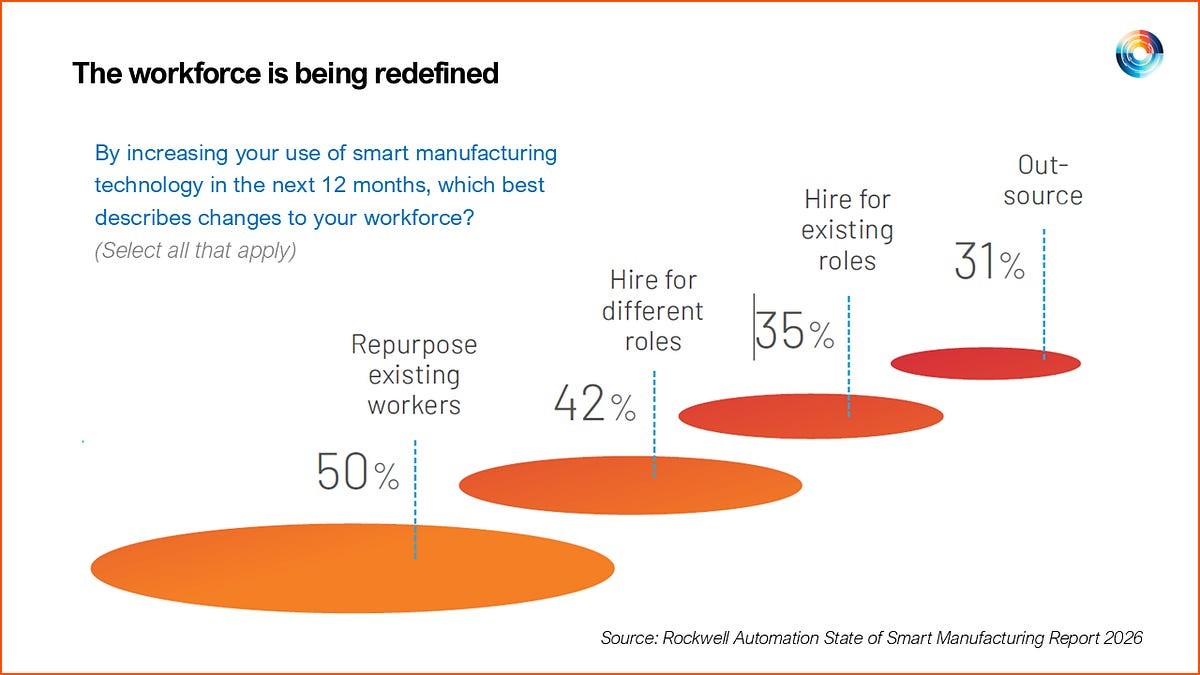
The workforce. That’s the primary bottleneck. Change management stress is up. Reskilling is expanding, fast. AI skills aren’t a “nice-to-have” for a specialist team. They’re a structural requirement now. You need it or you don’t build the future.
Then there’s the data paradox. Manufacturers are generating massive amounts of operational data. But they aren’t using half of it.
It’s just sitting there.
Closing that gap—between collection and action—is the next big hill. Until then, they have underutilised assets lying around.
Security remains a constant. As systems connect, the attack surface grows. Cyber risk is a daily operational consideration, not a quarterly review.
The Big Picture
This report has been running for eleven years. It’s a solid barometer. This year’s data came from 1,50 leaders, 62% of whom are decision-makers. Geographically, EMEA was the biggest slice at 41%. Saudi Arabia and the UAE alone made up 6%. The Americas took 30%. Asia Pacific? 28%.
Sectors ranged from auto to life sciences to consumer goods.
Here’s the kicker, though. Momentum is everywhere. Even among manufacturers who haven’t touched smart tech yet? 70% plan to buy in within 12 months.
So the race is on.
The Middle East is sprinting ahead, spending big and embedding AI deep into their OT. Others are starting to wake up.
Whether they can keep up with a 30% budget commitment and a 98% consensus remains to be seen. The tech is ready. The money is ready.
The people? That’s the hard part.