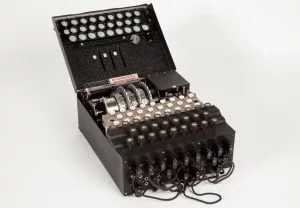
Eighty years ago, on a nondescript country estate in southern England, the course of history shifted. It wasn’t marked by a thunderous explosion or a sweeping military parade. Instead, it was quiet. Almost too quiet. British codebreakers had just achieved the impossible: they cracked the Enigma.
This wasn’t just about reading mail. The Enigma machine was the Nazi military’s primary encryption tool during World War II. By breaking its codes, the Allies gained access to German communications that were previously sealed shut. This intelligence coup is widely credited as a decisive factor in the Allied victory. But there’s a second legacy here. One that sits in every pocket you carry today.
The effort at Bletchley Park to automate the decryption process didn’t just win a war. It laid the groundwork for modern computing.
The Machine That Changed Everything
To understand the weight of this moment, you have to look at what they were up against. The Enigma was a cryptographic beast. It used a series of rotating wheels to scramble messages into gibberish. Every day, the settings changed. Every keystroke altered the wheel positions. The number of possible configurations was astronomical.
For decades, cryptanalysts tried to find patterns. They failed. The machine was designed to be unbreakable by human calculation alone.
The breakthrough at Bletchley Park wasn’t a single “Eureka!” moment. It was a grind. It was Alan Turing and his team refining the Bombe machine—a massive electrical device designed to test multiple Enigma settings simultaneously until the correct one was found.
The decryption of Enigma codes provided critical intelligence that shortened the war and accelerated the development of electronic computing.
Why It Matters for Your Daily Tech
You might think this is ancient history. It’s not.
The logic gates, the concept of programmable machines, and the sheer scale of data processing required to crack Enigma were direct precursors to the computers we use now. Without the pressure to break these codes quickly and accurately, the timeline for digital computing might have slowed down by decades.
Consider how you use technology today. You rely on encryption for everything from banking to messaging. The battle between encryption and decryption is ongoing. It started here.
The Enigma breakthrough proved that complex problems could be solved by mechanical and later electronic means. It validated the idea that a machine could follow a set of rules to process information. That is the fundamental definition of a computer.
The Human Cost of Intelligence
It’s easy to focus on the tech. But the people behind the screens at Bletchley Park were doing something terrifyingly risky. They were reading the enemy’s thoughts. The intelligence gathered from Enigma intercepts allowed convoys to avoid U-boats. It allowed troops to anticipate movements. Lives were saved.
Yet, for a long time, this contribution was hidden. The secrecy surrounding the work meant that these pioneers received little recognition during their lifetimes. The history books focused on the generals and the battles. The codebreakers faded into the background.
Now, we know. We understand that the digital age has its roots in that modest estate. The next time you unlock your phone or send an encrypted message, remember the wheels turning in southern England. The struggle to protect privacy and the drive to crack it started there
It’s hard to argue against its status as the most famous machine in history. The Enigma rotor cipher device. The decades-long race to crack its code. These elements have been immortalized in countless novels and films, most notably Christopher Nolan’s The Imitation Game. The hype isn’t just marketing. For a long time, the Enigma’s encryption was considered truly unbreakable.
Why the reputation for invincibility? Because it broke the rules of traditional cryptography.
Classical ciphers, like Caesar shifts or simple substitution, are vulnerable to linguistic patterns. You can use frequency analysis to spot which letters are common in a language. You can guess words based on context. It’s a puzzle of logic. The Enigma didn’t play by those rules. It combined multiple classical techniques into a mechanical chaos that defied human intuition.
A Machine of Controlled Chaos
The core of the Enigma’s power wasn’t just complexity for its own sake. It was the specific way it merged several cryptographic principles. It didn’t follow a linear, logical progression that a codebreaker could map out. Instead, it generated what looked like almost random output.
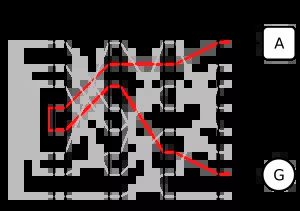
This “pseudo-random” nature was the killer feature. Every time you pressed a key, the electrical path through the rotors changed. The position of the rotors advanced. The plugboard swapped letters before they even hit the rotors. The combination of these variables meant that the letter ‘A’ might encode to ‘X’ on the first press, ‘K’ on the second, and ‘Q’ on the third.
“The Enigma didn’t follow a logical principle. It created a seemingly random cipher that rendered linguistic analysis useless.”
Why Language Analysis Stopped Working
For centuries, cryptographers relied on the fact that human language is predictable. English has common letters like E, T, and A. French has E and S. By tracking how often certain ciphertext letters appeared, analysts could make educated guesses about the plaintext.
The Enigma made this approach impossible. Because of the rotor stepping mechanism, the substitution alphabet changed with every single character. There was no static mapping. A frequency analysis of an intercepted message would show a flat distribution of letters. It looked like noise. It looked like pure random data.
There was no pattern to exploit. No “E” stood out as the most frequent letter. No recognizable word structures emerged from the gibberish. The machine effectively masked the linguistic fingerprints that cryptanalysts had used for millennia.
The Illusion of Randomness
Calling it “random” is a slight oversimplification. It was deterministic. If you knew the exact initial settings, the plugboard connections, and the rotor order, the output was perfectly predictable. But those settings changed daily, and the internal rotor positions changed with every keystroke.
This complexity created a security barrier that felt insurmountable. It wasn’t that the code was mathematically perfect in a modern computational sense. It was that the mechanical complexity outpaced the analytical tools available to human brains. The sheer number of possible configurations dwarfed the ability to brute-force or logic-out the solution.
The result was a system that felt like a black box. You put text in. You got noise out. And without the internal mechanics visible, the path from input to output was a

How the Enigma’s rotors actually scrambled messages
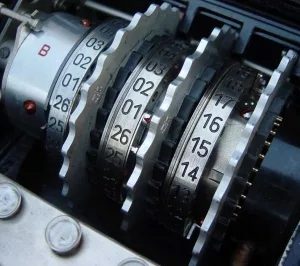
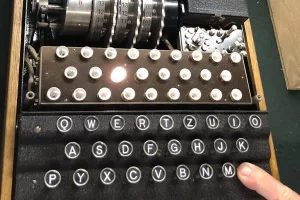
The heart of the Enigma wasn’t magic. It was three, and later four, rotating wheels. Each wheel held the 26 letters of the alphabet. You pressed a key. The electricity ran through the machine’s internal wiring. The wheels shifted. The output letter changed.
It sounds simple until you realize every single press changed the position of the wheels. An “E” typed at the start of a message would look completely different from an “E” typed at the end of the same message. The cipher evolved with every keystroke.
Complicating matters further, operators didn’t just leave the rotors in one spot. They inserted them into the casing in new, random configurations for every deployment. The encryption settings were fluid. You couldn’t crack the code unless you had a physical Enigma machine. And even then, you needed the exact daily settings. Without those specific configurations, the ciphertext was just noise.
Who built the German cipher machine
Arthur Scherbius designed it. He was a German engineer who didn’t start from scratch. He built his initial encryption device on the backbone of an American precursor. By 1918, Scherbius had created the first rotor-based encryption machine and filed for a patent.
The military didn’t bite immediately. They saw no immediate utility in his “writing Enigma.” Scherbius had to sell it himself. He took the machine to trade shows. He demonstrated its potential to skeptics who just wanted conventional radios.
It took years. Finally, in 1926, the German Navy (Kriegsmarine) made the leap. They adopted the Enigma to encrypt radio transmissions at sea. The logic was sound. Radio messages could be intercepted. Encrypted messages could not be read without the key.
By World War II, the machine had become the backbone of military communication. It wasn’t just for the navy. Army units, air forces, and intelligence agencies relied on it. Land and sea operations were tied together by the clicking of those rotors. If you wanted to understand German strategy during the war, you didn’t just read their reports. You had to break their machine.
Why the settings mattered more than the hardware
The machine itself was robust. The weakness was in the human element. The daily settings.
Operators would swap the rotors. They would change the ring settings. They would plug cables into the front panel (the plugboard). This added another layer of complexity. A message sent on Monday couldn’t be read with Tuesday’s settings.
You couldn’t crack the code unless you had a physical Enigma machine. And even then, you needed the exact daily settings.
This is why the Enigma was considered secure for so long. It wasn’t just about the engineering. It was about the sheer volume of possible combinations. Millions of daily setups. Billions of potential rotor orders.
The Germans thought they were untouchable. They believed the complexity of the rotor movement made the code unbreakable. They were wrong. But getting to that breaking point required more than just understanding the mechanics. It required patience. And resources. And a lot of coffee.

The Mechanical Heart of the Enigma Breakthrough
Allied cryptographers were stuck. No matter how hard they tried, they couldn’t crack the German military’s radio transmissions. The result was catastrophic. They had no idea where U-boats or surface ships were lurking in the Atlantic. Supply convoys moving from the US to the UK were sinking left and right. It was a logistical nightmare.
Alan Turing changed the equation.
He arrived at Bletchley Park in 1939. This was the secret hub for British codebreakers. He didn’t start from scratch. Polish mathematicians had already built a simpler precursor. Turing took that foundation and engineered something far more powerful: an electromechanical device dubbed the “Bombe.”
The name came from the sound. It ticked.
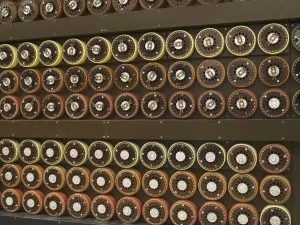
The machine worked by eliminating possibilities. An Enigma cipher has infinite combinations. The Bombe narrowed those down to just a few viable settings. It did this using dozens of rotating drums. Each drum held letters. Each drum simulated a different position of the Enigma rotors. It wasn’t magic. It was brute-force calculation, faster than any human could manage.

Guessing the rotor settings wasn’t magic. It required a foothold. A known word. A fragment of plaintext where the cipher text had to match.
Bletchley Park cryptographers had to hunt for these weak points. German radio operators left them everywhere. Predictable phrases repeated in every message. “Oberkommando.” The dreaded “Heil Hitler” at the end.
But there was one phrase that appeared daily. With ruthless consistency.
It wasn’t a salute. It wasn’t a military command.
It was the weather.
Why the Weather Report Mattered
German meteorological reports were sent at the same time, every single day. They followed a rigid format. And in that format, the word “Wetter” (weather) always sat in a prominent, predictable position.
This wasn’t just convenient. It was a goldmine for Alan Turing and his team.
They called these known plaintext attacks “cribs.” If you know what part of the message should read “WETTER,” you can test rotor positions against the intercepted cipher text. You stop guessing blindly. You start testing specific alignments.
The logic was simple. If the machine settings produced “WETTER” in the right spot for a given date and time, you were close.
The Grind of Paper and Metal
Getting to that match wasn’t instant.
Turing’s initial breakthroughs were theoretical. The practical application was brutal. It required physical labor.
First came paper stencils. Workers would manually align crib patterns against intercepted traffic. It was tedious. It was slow. It was error-prone.
Then came the machines.
Turing led the development of the Bombe. Not to decrypt messages directly. To test rotor settings. The Bombe would spin through permutations, eliminating impossible configurations. If the “Wetter” crib didn’t match, the rotor position was discarded.
If it did match, the machine stopped.
This narrowed the field. It reduced millions of possibilities to a handful of likely candidates. Operators then checked those settings on Enigma replicas.
For a while, it seemed like a dead end. The cribs helped. But the sheer volume of traffic, combined with the complexity of daily key changes, made progress agonizingly slow.
The Human Cost of Prediction
It sounds clever. It was exhausting.
Cryptographers sat for hours, staring at wheels and plugs. They relied on the German operators’ laziness. Their discipline. Their refusal to vary the weather report.
Every “Heil Hitler” was a clue. Every “Wetter” was a key.
But even with these advantages, the code didn’t fall easily. The initial leads were promising. The machines were built. The stencils were cut.
Yet the Enigma remained stubborn.

The Code Breakers Finally Win
The stalemate shattered on January 17, 1940. For the first time, cryptologists at Bletchley Park managed to crack a German Enigma message. It wasn’t pretty. They did it by hand. It took days. Sometimes weeks.
In a war moving at machine-gun speed, that is useless intelligence. By the time you read the message, the tanks have already rolled.
Enter the Bombe.
Alan Turing and his team needed to automate the brute-force guessing of rotor settings. The German Enigma machine had roughly 17,576 possible rotor positions. Humans couldn’t check them all. The electromechanical Bombe machines could. They whirred through the possibilities, narrowing down the daily settings in about 20 minutes.
Suddenly, the noise became signal.
Why This Changed the War
This wasn’t just about reading letters. It was about seeing the battlefield.
By listening in on German military traffic, the Allies could track U-boat movements in real-time. Before Enigma decryption, the Battle of the Atlantic was a meat grinder. Ships sank. Supplies didn’t arrive. After the Bombe came online, the Allies could reroute convoys. They stopped the U-boat wolfpacks cold.
It wasn’t just the Atlantic either.
- Intelligence from Enigma helped shape tactics in the Mediterranean.
- It played a key role in the planning for the Normandy landings.
- It allowed Allied commanders to know what the Germans were planning before the Germans executed it.
Without this advantage, the outcome of the war would have been far less certain. Most historians agree that cracking Enigma shortened the Second World War by years.
Millions of lives. That’s the real cost saved. Not just soldiers on a battlefield, but civilians in bombed cities.
The technology worked. The code held. And then it didn’t.