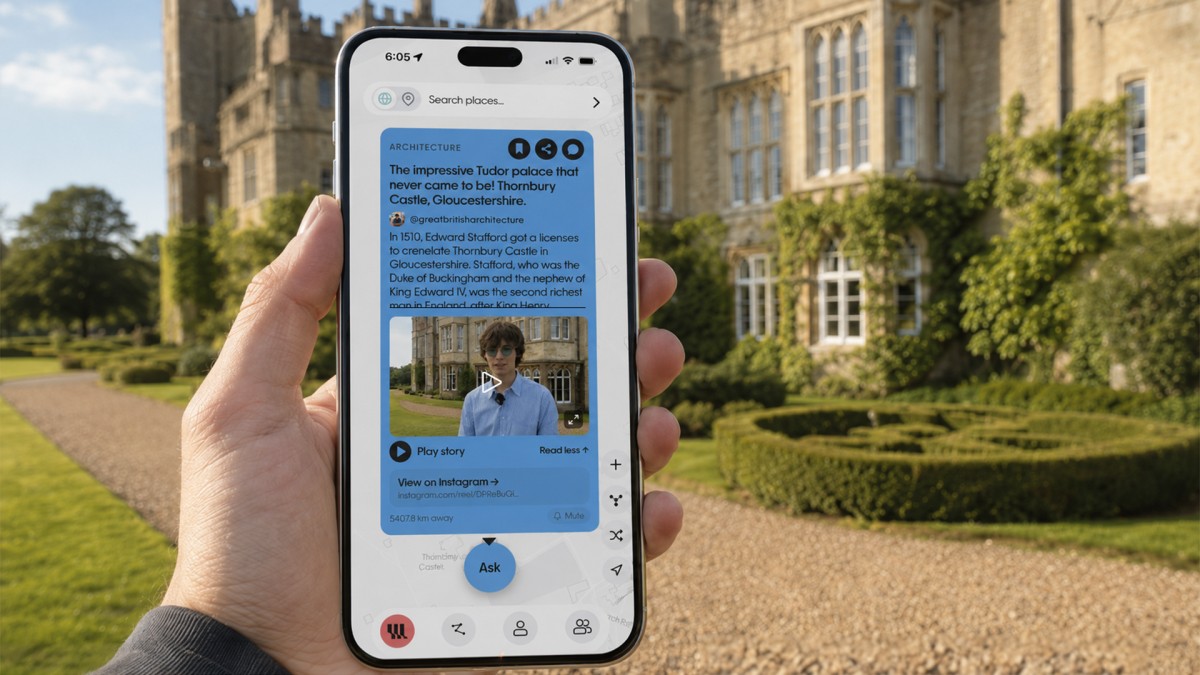
Most people walk through cities with their heads down. Staring at screens. Trying to find the path. Or worse, trying to decode a museum map that feels like a puzzle designed by someone who hates joy.
But the world around us? It has a story.
A new app called Wrinkles wants to unlock that narrative without breaking your stride. Available on iOS and Android, it acts as an AI-driven audio guide. It uses your location to surface local history, secrets, and lore automatically. No searching required. Just walk. Listen.
It’s not just for tourists. It’s for anyone curious enough to look up.
The friction of traditional museum apps
The spark for Wrinkles came from frustration. Specifically, David Stemler, an advertising veteran, and Ryan Hansan, the founder of previous ventures like ScratchDC and TasteLab, were thinking about the gaps in how we experience places.
Stemler hit his breaking point at the British Museum in London. He was using an official self-guided tour app. The design was clean. The content was presumably good. But the experience? It sucked.
“I spent the entire visit heads-down,” Stemler said. “Matching numbers on the walls to lists on your phone instead of taking in your surroundings.”
He was learning, technically. But he wasn’t there.
So, he called Hansan. From the airport, with the flight check-in looming, he asked the question that started the whole thing. If your phone knows exactly where you are in the physical world, why can’t the physical world speak back to you?
They’ve been friends since middle school. They travel together. They argue over how things could be better. Wrinkles is the result of that same restless curiosity.
Building a global map of hidden stories
Today, Wrinkles has a massive footprint. The app features 1.3 million “Wrinkles”—points of interest—spanning 177 countries.
That’s a foundational layer of history and local trivia. But it doesn’t stop there.
Historians, museums, and even brands can add their own narratives to the map. Users discover these stories by moving through the world, or by browsing remotely if they’re planning a future trip.
The app supports a conversational interface. It feels less like a static encyclopedia and more like a live tour. You’re listening to the origin story of the Trevi Fountain? You can pause and ask, “Where does that water actually come from?” The app responds in real time.
It answers the specific “how” and “why” questions that pop into your head when you’re standing in front of something ancient.
More than just a travel guide
Travel is a use case. But the founders argue it’s not the defining feature.
“Travel gets used once a year,” Hansan explained. “Curiosity is constant.”
They want Wrinkles to be part of the daily grind. Your commute. The botanical garden. The zoo with the kids. Or maybe just standing outside your childhood home, remembering.
The social and personal features reflect this broader intent. Users can follow friends, family, and creators. They can save stories. But they can also attach personal artifacts to locations.
Photos. Video clips. Audio recordings.
Families can collaborate on digital timelines tied to physical spots. That first date corner. The treehouse in the backyard. It preserves legacy. It turns geography into memory.
How it makes money (and why you don’t pay)
Here is the twist. The app is free for users.
Stemler and Hansan experimented with a freemium model but realized they didn’t need to nickel-and-dime the curious public. Instead, Wrinkles operates on a supply-side revenue model.
Museums, tourism boards, universities, and hotels pay to create location-based experiences. They don’t have to build their own clunky apps. They plug into Wrinkles.
Businesses can also promote Wrinkles linked to their locations. If you’re listening to a guide about a historic district, and you want to book a tour, reserve a table, or buy a ticket, those links are built in. The app takes a cut of those transactions.
Creators and media partners build sponsored guides. It’s a sustainable loop that doesn’t require an ad-filled, clunky user interface.
The long game
The vision is simple. They want Wrinkles to become the default layer for understanding places.
Whether you’re navigating a college campus, rediscovering your hometown, or planning a trip to Spain, the app is there. It turns navigation into discovery.
It stops treating the city as just a grid of streets to be crossed. And starts treating it as a living, breathing archive.
So next time you walk down your street, look up. What’s the story there?
The answer might be waiting.