How #MobileTV works and why it ultimately matters
Widespread mobile television has been a long time coming. TV-compatible mobile phones have been available in South Korea since 2002. In the original version, TV signals were transmitted over standard mobile phone networks. This means per-minute viewing fees and a terrifying phone bill.
In 2003, Samsung and Vodafone launched mobile phones in South Korea and Japan that can receive local analogue TV broadcasts for free. The video was choppy, and it drained the phone battery.
The real “mobile TV revolution” has only just begun. Telecommunications companies are introducing high-quality mobile phones equipped with digital TV and at the same time building broadcast networks to deliver content. This article looks at some of the types of mobile televisions in development and the mobile phones that receive the signal.
Basic concepts of mobile TV
The basic idea of the TV phone is pretty simple It’s a cell phone that acts as a TV receiver. If you’ve ever read How TV Works, you know that a TV signal is just a radio signal. Mobile phones are constantly receiving radio signals. This is what they do.
In video calls, you can receive wireless signals in the frequency band assigned to your television. It does this in addition to the frequency bands reserved for mobile phone voice data. For example, in the United States, videophones are tuned to 2110-2170 MHz for calls and 54-60 MHz for TV channel 2 reception.
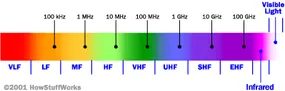

The hardware inside your video phone isn’t magic. It’s just a regular receiver that takes sound and image from radio waves and illuminates the screen. Simple. But what if you want to get a signal on your pocket device? Here’s a real headache.
Streaming video over mobile networks consumes a lot of bandwidth. Early “2G” GSM networks had a maximum transmission speed of 10-14 kilobits per second (Kbps). Try watching the show at this speed. A slide show will appear. Even 30-100 Kbps “2.5G” networks produce choppy and unwatchable artifacts.
Second, there is a huge amount of data. Voice calls require little space. Live broadcast? Not so much. Try sending thousands of simultaneous streams through an infrastructure built for calls. Network congestion. It grinds to a halt.
And don’t forget the batteries. Processing video drains the battery faster than you can call it “power saving mode”. Early devices only lasted minutes instead of hours.
How does 3G solve the bandwidth bottleneck?
Technology has not only advanced; It’s a game changer. Enter “3G” network.
These broadband-style connections offer data transfer speeds of 144 Kbps to 2 Mbps. Suddenly, your live video no longer looks like a questionable PowerPoint presentation. However, raw speed alone is not enough to prevent the network from collapsing under the weight of demand. The is where multicasting comes into play.
Most mobile data uses “unicast”. Request a live stream. The server will send you a unique copy just for you. If 10,000 people watch the same game, the network will broadcast 10,000 copies. The is ineffective. What a waste.
multicasting flips the script. The allows several subscribers to use one transmission stream. One signal. Thousands of viewers. The network remains relaxed. The load decreases.
Time Slicing: Save power
Speed and bandwidth are only half the battle. The other side is to prevent your phone from getting destroyed in your pocket.
Manufacturers have implemented a time slicing to solve the power consumption problem. Instead of sending video continuously, data is sent at regular intervals. The receiver receives chunks of data. Then it closes. It sleeps. Wake up in time for the next burst.
The technology significantly reduces power consumption. You can watch programs without the battery draining before the credits roll.
Are you ready for mobile TV?
You may be able to subscribe right now. Services include MobiTV, Sprint TV and SmartVideo. But only if you have the right hardware. you’re betting on a shaky foundation.
Broadcasting and transmission standards for mobile TV are still in their infancy. Protocols change. Competitors fight for supremacy. Users have no choice but to wait for a unified standard that is not tied to one operator or one phone model.
“Mobile TV transmission and broadcast method standards are still in their infancy.”
Gone are the days of slideshows. We’re past the battery-drain nightmare. However, the finished product is not ready yet. The infrastructure is under construction. These methods are being tested.
What happens next? How can we deliver these broadcasts at scale? The

WiFi and WiMAX: Streaming via the Network
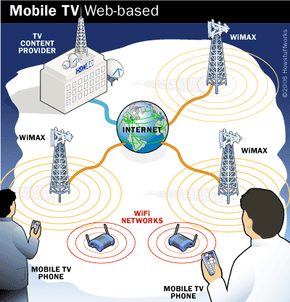
You no longer need to be locked to a specific TV tower to watch live broadcasts. The infrastructure is changing. You can also pull live broadcasts to your phone via satellite, but terrestrial towers and WiFi networks are also now a viable option. Each method has its own technical backbone.
How WiFi Broadcasting Really Works
Basically, this approach treats TV like any other data stream. It spreads through the Internet. If your smartphone has data capabilities and is connected to a WiFi hotspot or WiMAX coverage area, you should be fine. The signal is not bouncing off a dish in the sky. It’s riding existing broadband pipelines.
Sling Media complicates things a bit. Their Slingbox does not receive signals directly from broadcast stations. It picks up the signal that already reaches your home TV. The hardware then “placeshifts” the signal. It is sent to the mobile receiver via your home internet connection. This can be a laptop or a web-enabled mobile phone. You basically borrowing your home signal and beam it somewhere else.
Terrestrial: Old School Physics, New Tech
Land-based methods, the Internet is completely ignored. It uses analog or digital television signals that are broadcast over the air. These are sent from ground stations. The hardware requirements are simpler than before. All you need is a phone with a TV antenna. Add an analog or digital TV tuner to receive the signal directly. No data plan is required. Just physics.
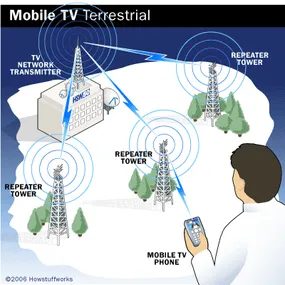

The mobile TV landscape is by no means monolithic. It was a chaotic mix of analog signals, digital over-the-air broadcasts, and early 3G network broadcasts. Standards such as T-DMB (Terrestrial Digital Multimedia Broadcast), Qualcomm’s own MediaFLO, MBMS and DVB-H compete for airtime. They all leaned heavily on 3G infrastructure, the underlying design is very different.
Let’s take DVB-H as an example. Digital Video Broadcasting – Short for Handheld. It is not built from scratch. It is a variation of the terrestrial DVB standard used to provide free-to-air digital television to European homes. The goal is simple: to make that home broadcast work on a pocket-sized screen.
The design behind the signals
The magic here is Orthogonal Frequency Division Multiplexing (OFDM). This may sound like jargon, but it’s a smart way to compress your data. Instead of blasting one signal, OFDM spreads the data stream over several channels in the same bandwidth space.
This looks confusing to the receiver, but the system modulates different signals at different frequencies. The phone determines which signals to listen to and which to ignore. Then pull together relevant information from different sources.
“OFDM allows providers to transmit multiple signals within a bandwidth, so receivers can decide which signals to listen to and which to ignore.”
The content producer starts the chain. Record live video and audio. The video is encoded with H.264. The sound is encoded with AAC. The encoder sends the Stream to the 3G streaming server. The server then sends the data to several transmission towers. These towers cover the area.
Power consumption was the killer of early mobile TV. DVB-H solves this problem with Time Slicing. Reduces power consumption by putting the receiver to sleep between data bursts. What is the typical maximum transfer rate for this system? 15Mbps. It’s fast enough to play smooth videos, but not so fast that it drains your battery in 20 minutes.
Satellite Broadcasts
Not everyone wants to trust a ground tower. Some standards used satellite broadcasting to push live television to mobile phones. The delivery paths varied. You can connect directly to your phone from the satellite. You could hit a base station first and then to the phone. Or you can use both methods at the same time.
This is one way to avoid congested frequencies in terrestrial networks. But it also brings its own hardware challenges.
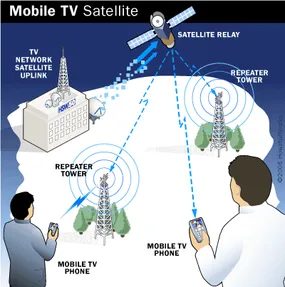

Two different architectures, MBSAT and S-DMB, rely on hybrid delivery to solve mobility problems. Let’s see how S-DMB actually works.
The content server pushes the live TV signal to the encoder. Usually MPEG-4 is used for video and AAC for audio. The coded stream is sent directly to the S-DMB satellite. The satellite operates in the Ku-band frequency range 13.824-13.883 GHz.
This is where it gets interesting. Geostationary satellites do more than just talk to your cell phone. It rebroadcasts signals to two different destinations at the same time.
It is first transmitted to a terrestrial repeater at 12.214-12.239 GHz. Second, it transmits the signal directly to your phone on the S-band (specifically 2.630 to 2.655 GHz).
Why bother installing ground posts? Because the satellites have line of sight problems. Satellite signals can be blocked in cities surrounded by tall buildings or deep in subways. Terrestrial repeaters fill these gaps. They act as local amplifiers.
The system carefully coordinates these dual broadcasts. If you’re walking down the street and you’re within range of a satellite and a ground tower, your phone will receive both signals. Together, they create a stronger and more stable connection. This dual reception method allows the S-DMB system to sustain 128 Kbps data transfer rate. This is more than enough for a decent mobile TV, as long as the hardware can handle the decoding.
Global rollout and market timing
Although WiFi broadcasts are ubiquitous, dedicated mobile TV systems require special infrastructure. S-DMB didn’t stay theoretical for a long time. The service was launched in South Korea in mid-2005. This was one of the first major deployments of its kind.
DVB-H (Digital Video Broadcasting Handheld), on the other hand, took a slightly different timeline. The first commercial launch took place in Italy in June 2006. Since then, trials have been scattered across the globe to test how well the standards work in different environments.
The technology is ready. Infrastructure is being developed. But what about the hardware? This is the next hurdle.
Mobile TV reception

Hardware behind the signal
Basically, you are looking at a radio receiver. This is a TV tuner. It doesn’t matter if you’re watching on a bulky fixed device or a small handheld device. core technology has not changed. It captures radio frequency signals and converts them into something you can see.
Content producers broadcast these signals in specific frequency bands. Like tuning an AM/FM radio to a station, the tuner locks onto a specific channel frequency. Picks up radio waves from an antenna. Then the video and audio data strips out.
The tuner sends these raw signals to the audio/video processor. This hardware decodes and formats the data so that the display electronics can actually create the image.
This is a multi-step translation process. First comes the signal. The processor then translates it. Finally, it is displayed on the screen. Understanding this chain can explain why some devices drain their batteries faster than others.
Analog reality and digital efficiency
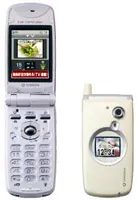
Consider Toshiba’s V401T. This is one of the few analog video phones on the market. Receives exactly the same signal as a traditional “rabbit-ear” TV. There are no monthly fees for viewing. There are no subscription. Just open airwaves.
The internal hardware is rudimentary, but functional. Built-in analog tuner and antenna. The screen is a 2.2-inch QVGA screen with a resolution of 320×240. It can produce 30 frames per second. This is a standard motion.
But there’s a problem. You can only watch for about 1 hour on a single charge.
Why did it die so fast? This is because power is required to digitize analog signals for digital display. Your phone must convert these incoming radio waves into digital data that your display can understand. This is an energy intensive task. Digital receivers can handle this problem more effectively. An analog phone? They burn through juice.
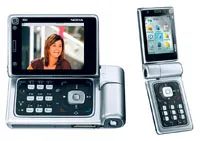

Nokia N92 DVB-H Review: Mobile TV 2006
Battery life is about 4 hours on a single charge. That’s pretty good for a DVB-H receiver released in mid-2006. The hardware inside is a TV antenna and a digital tuner. It listens to radio bands 470 – 702 MHz. Think of it like a digital TV receiver in your pocket.
The processor drives 30 frames per second. The screen is 2.8 inches. You get QVGA resolution. There are 16 million colors. The highlight here is the swivel screen. Twist it. Switch to landscape mode. Or leave it upright. It adapts to how you want to watch.
An Electronic Service Guide is also available. Displays programming and other information. You can record up to 30 minutes of TV programs. Save it. Play it back later. Not bad for a mobile phone of the time.

The future of mobile entertainment
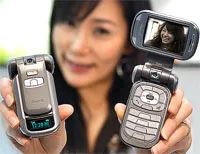
Samsung introduced the SCH-B250 to the Korean market in March 2006. This is more than just a phone. This is a satellite-TV phone. This device has a built-in S-DMB receiver and its own antenna. You get a hi-res QVGA screen. By default, it is horizontal. Swivel it, and it flips to portrait. Hold the phone upright while doing this.
There is a video output connection on the side. Connect to a larger display and push S-DMB content out. Battery life offers up to 3 hours of TV viewing. That is a solid chunk of time.
The supply is currently tight. There is a shortage of Mobile-TV handsets. The reason is simple. The content-delivery systems have not yet been widely adopted. We are waiting for infrastructure. But change is coming. Expect changes in the next 6-18 months. As content delivery increases, so do the functionality on the receiving end.

Hardware-based screen improvements
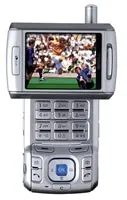
Introduced in early 2006, the LG V9000 is a T-DMB receiver with virtual surround sound capabilities. This is more than just a phone. It was a small theater. Around the same time, LG introduced the SB130 prototype. This S-DMB device could pause live TV. It recorded up to 1 hour of programming with the internal memory. These features represent change. Mobile phones with TV capabilities are more than a novelty. Their goal is a satisfying viewing experience. Entertainment on the way to work is no longer an afterthought.
Larger screens will likely follow. As the availability of mobile TV content increases, screens must also grow. Analysts are predicting dual displays. Call and web browsing on one screen. Another is dedicated to streaming videos. This hardware change is required. High end features like HDTV reception require more power. To support this, battery life must be extended.
Ads and dual screen reality
High-end video phones have opened up new advertising channels. Companies like to embed web links in their programming. Users can click to buy products during the show. This functionality may require dual monitor capabilities. Watch ads on one screen. You browse the product on the other. This is a direct path from content to commerce.
DRM barriers and licensing costs
Enthusiasm is still high. However, there are still obstacles in terms of equipment and content. Service providers must obtain programming licenses from the major networks. These fees increase the price of your subscription. Digital Rights Management (DRM) is another headache. Companies need solutions that limit user behavior. You must protect the copyrighted content on your mobile phone.
Remember all the fuss about DRM for DTV, DVD, CD and MP3? It’s confusing here too. Users object to restrictions. The service provider fights copyright infringements. It’s a tense balance. Maybe everyone will just get along for mobile TV. Probably not.
More information about mobile technology
Related articles
- How mobile phones work
- Cell Phone Quiz
- 10 popular mobile phones
- 5 new phone technologies
- Digital rights management system
- How digital TV works
- How the radio works
- How satellite TV works
- How Slingbox works
- How smartphones work
- How television works
External links
- BetaNews: Microsoft Joins DVB-H Consortium
- DVB-H: Mobile TV around the world
- Telecom ABC: Mobile TV
- Texas Instruments: Texas Instruments Brings Live Digital TV to Your Cell Phone – Oct 21, 2004
Leave
- “3GSM 2006: Experience LG’s DVB-H video phone.” Technology Digest
- Baig, Edward C. “Channel Surfing on Your Phone with MobiTV” USA Today website. February 11, 2004
- DVB-H: Mobile TV around the world
- Hesseldahl, Arik. “The Cell Phone That Lets You Watch TV” Forbes.com. July 29, 2003
- “Honey, what’s on your phone tonight?” ZDNet News. February 6, 2006
- Kharif, Olga. “Video phones are ready for prime time.” Business Week online. December 1, 2004
——”Mobile TV.” Telecom ABC - Mobile TV
- “MobiTV cooperates with IPWireless.” CNET News.com. February 8, 2006
- “Orthogonal frequency division multiplexing tutorial”. wave report
- “Orange tests MBMS-based solution in UK Unpaired 3G Spectrum.” IPWireless
- PC magazine glossary
- Qualcomm MediaFLO
・”Sanyo’s Digital TV Phone”. MobileBurn - “Satellite DMB service”. SK Telecom
- Sundgot, Jørgen. “LG V9000 rotary phone with TV capability announced.” infoSync World. February 17, 2006
-Williams, Martyn. “Take your satellite video phone to town.” PCWorld.com. October 19, 2005
-Williams, Martyn. “Samsung phones now have TV reception capability.” PCWorld.com. June 12, 2003