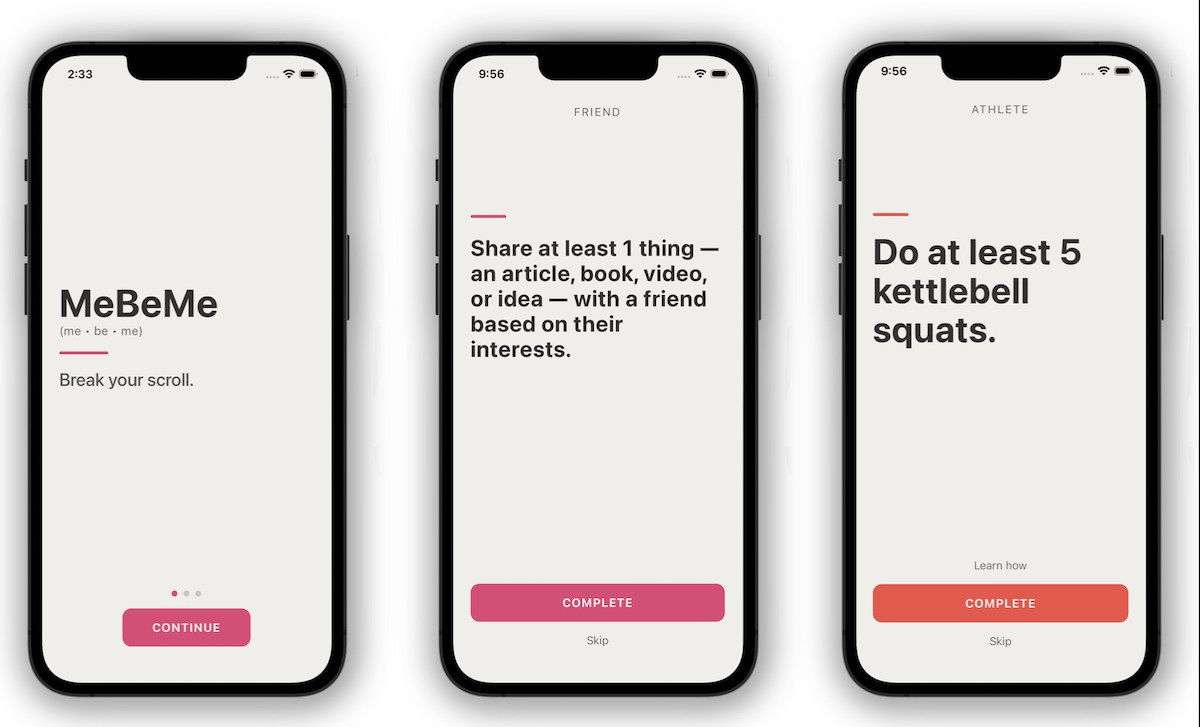
The endless scroll isn’t just a bad habit. It’s a trap that steals hours and leaves you feeling hollow. Most apps trying to fix this problem use brute force. They lock you out of Instagram or block TikTok entirely. It works, sometimes, but it also feels like a digital prison.
Enter MeBeMe.
This isn’t another digital handcuff. It’s an “interrupter” designed to pull you out of doomscrolling and push you toward real life. Instead of punishing you for wasting time, it nudges you to become your best self through small, actionable missions.
How Identity-Based Habit Building Actually Works
Most self-improvement advice fails because it’s too vague. “Be healthier” is not a task. “Drink water” is barely a start. MeBeMe operates on a different psychological principle: identity formation.
When you open the app, you don’t just set goals. You choose an identity.
You might identify as a “lifelong learner” or a “classics reader.” The app then delivers specific missions tied to that label. If you pick the latter, you won’t get a notification telling you to stop scrolling. You’ll get a suggestion to attend a local book club. Or listen to a seven-minute educational video.
The logic is simple. You act the part, so you become the part.
The app currently offers more than 75 distinct identities. These aren’t generic categories. They are specific roles across four main pillars:
- Mind: Mathematician, historian, chess player, or scientist.
- Body: Athlete, dancer, runner, or cyclist.
- Relationships: Focused on connection and presence.
- Home: Cooking enthusiasts or gardeners.
You aren’t limited to just one. You can select multiple identities to build habits across different spheres of your life simultaneously.
Control Over the Interruptions
One reason these apps often fail is their aggression. Constant buzzing on your lock screen adds to the digital noise it claims to solve.
MeBeMe flips this. Users decide the frequency. Want a daily nudge? Fine. Want occasional reminders to check in? You have that choice too.
There is also a accessibility feature worth noting. The “Break Your Scroll” function uses Siri to read the mission prompts aloud. This is useful if you are driving, cooking, or just need to step away from the screen without typing anything.
“Small actions, repeated over time, shape who are,” writes creator Eric Wolfram. “Becoming who you are a lifelong project.”
Wolfram didn’t set out to build a productivity empire. He built MeBeMe initially for his son. He realized later that he needed the structure just as much as the kid did. It launched last Wednesday, marking a shift from personal tool to public app.
Privacy as a Default, Not a Feature
In a landscape defined by data harvesting, MeBeMe stands out by doing almost nothing with your info.
There is no account required. You do not sign up. You do not upload a photo or link your social media. All data stays on your device.
Wolfram explicitly allows users to turn off anonymous usage sharing entirely. It is a stark contrast to the subscription-based, data-driven models that dominate the wellness app sector. You are not the product here.
Is It Enough to Stop Doomscrolling?
No single app will cure the algorithmic pull of social media. The designs behind TikTok and Instagram are engineered by the world’s brightest minds to keep you watching. A simple notification will not always win that war.
But MeBeMe offers a different kind of resistance.
It doesn’t ask you to fight the scroll. It asks you to look up. It reminds you that you are someone who reads, or moves, or learns. And sometimes, remembering who you want to be is enough to put the phone down.
The real question isn’t whether the app will change your life. It’s whether you are tired of wasting it.