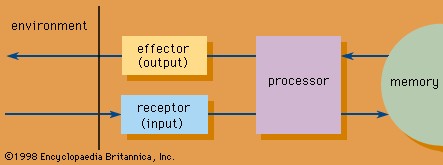
It sounds like a dry, academic definition until you realize it’s the engine under the hood of your morning routine. Information processing is the mechanical act of taking raw input, shuffling it around, and spitting out something useful. We used to think of this in terms of punch cards and mainframes. Today? It’s almost entirely computer-based. It is the invisible architecture that locates your data, uses software to reshape it into a specific format, and displays it where you need it.
Think about the last time you typed a query into a search engine. You didn’t just “search.” You engaged in a complex loop of acquisition, recording, organization, and retrieval. The system had to find the information, capture it, manipulate it to match your intent, and output the result in a readable display. That is information processing in real time.
From Raw Bytes to Displayed Reality
The process is linear in theory but messy in practice. It starts with acquisition —locating and capturing the information. This could be a sensor reading from an IoT device, a text string from a user, or a file scraped from a website. Once captured, the data isn’t useful yet. It needs to be organized.
Then comes the manipulation. Software takes that raw, often chaotic input and refines it. This is where data processing (a related, often overlapping term) kicks in. The system applies logic, filters, and algorithms to transform the data into a desired form. Finally, there is the output. The information is retrieved, displayed, and disseminated to the end-user or another system.
Why the Distinction Matters
You might be wondering, why split hairs between “information” and “data”? The difference often lies in context and usability. Data is raw facts. Information is data that has been processed to have meaning. A spreadsheet of temperatures is data. A chart showing a warming trend over ten years is information. The processing step is what bridges the gap.
This distinction is critical because it dictates how we build tools. A sophisticated information-retrieval system isn’t just a database. It’s a tool designed to manage the entire lifecycle: from the moment a piece of content is created to the moment it’s pulled into a search result, a dashboard, or an email alert.
The Role of Search Engines
An Internet search engine is perhaps the most ubiquitous example of an information-processing tool. When you type a query, the engine doesn’t just hand you a list of links. It processes your intent against billions of indexed pages. It ranks, filters, formats, and displays the results based on relevance, speed, and authority. Every click, every suggestion, and every snippet is the result of complex processing operations happening in milliseconds.
Beyond the Screen
While we associate this with screens and servers, the concept extends further. Any sophisticated system that moves information from point A to point B in a structured way is engaging in this process. It’s in the background of your banking app, your navigation system, and the recommendation algorithms on streaming platforms.
The technology evolves. The methods change. But the core loop remains the same. We capture. We organize. We output. The question isn’t really whether information processing happens—it happens constantly. The real question is whether we’re designing systems that process information for us,