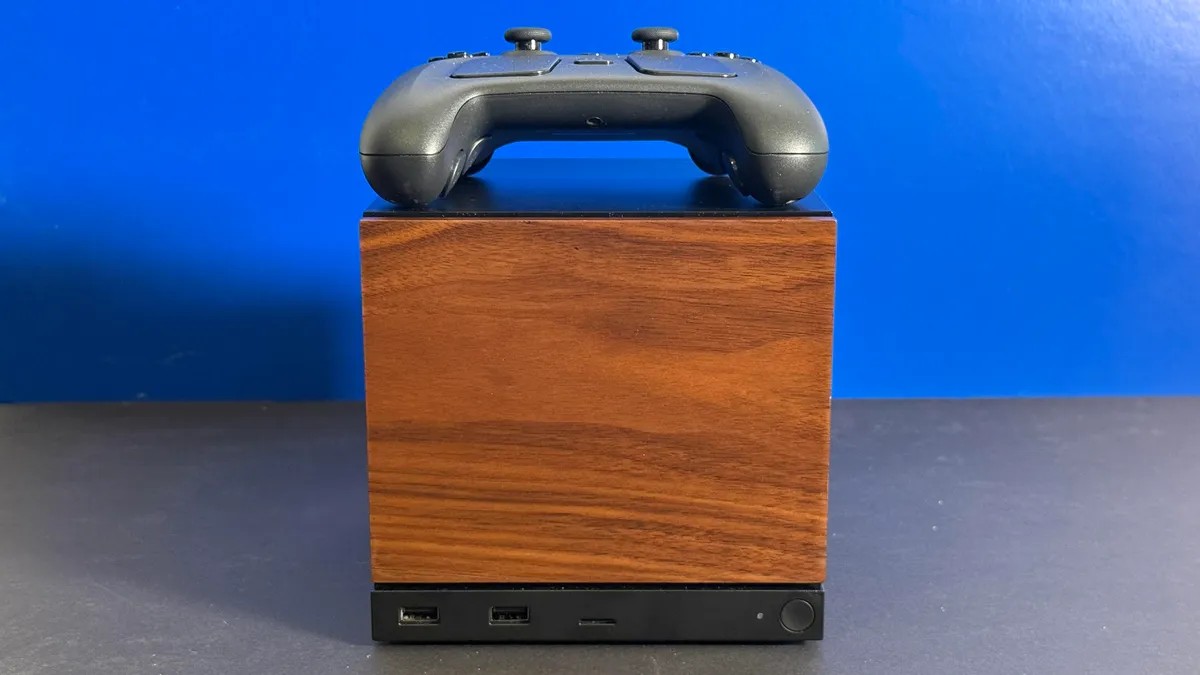
The box is small. Too small, almost.
I knew it looked compact last November, but holding it now—carrying it on a trip with friends—I’m still struck by it. This cube fits next to any TV. It’s denser than an egg, heavier than it looks, yet shockingly portable compared to the bricks we call consoles today.
It is not a Steam Deck. It is not portable in the handheld sense. It’s a fixed console, plugged into a power outlet, tethered to a monitor or TV.
And it’s expensive.
Starting at $1,049, the Steam Machine enters a market where electronics are inflating and wallets are deflating. RAM costs more. SSDs are pricey. Even legacy hardware like the Xbox Series S or PlayStation 5 sees price hikes. For a PC gaming box that starts above the $1,000 mark, you have to wonder: why buy this when your laptop already runs Steam?
Why buy the Steam Machine instead of a Steam Deck or PC?
This is the elephant in the room. Valve already owns the portable PC gaming space with the Steam Deck. That device has a screen. It fits in your lap. It was originally affordable. The Steam Machine shares only the “Valve magic” aspect of being small and console-like. It lacks portability.
Yet, if you hate the bulk of a desktop tower or the heat of a laptop sitting on your desk, there’s something appealing here. I feel repelled by home PCs because they take up space. The Steam Machine does not. It sits on a shelf. A mantel. Beside your gaming monitor without looking like an alien invasion.
No bulky power brick, either. Just a cable that plugs in.
The design itself is a ventilation system. The whole cube is an air intake and exhaust. The back is dominated by a fan grill. The front features a magnetically swappable faceplate—two included options, one red fabric, one plastic woodgrain. You snap them on. You change the look. It feels tactile. Premium.
There’s a minimal power button and an LED strip at the base. This light bar tells you when games are downloading, even if your TV is off. You glance down. The bar fills. Game ready. It’s simple UX done well.
Steam Machine specs vs performance: Does it compete with PS5?
The hardware inside isn’t secret, but the implementation is tricky. All models, regardless of price tier, share the same core components:
- AMD Zen 4 CPU
- Custom AMD RDNA 3 GPU
- 16 GB DDR5 RAM
- 8 GB GDDR6 VRAM
- microSD slot for expandable storage
My review unit was the top-end model ($1,428), packing 2 TB of storage, two extra faceplates, and the beloved Steam Controller. The base model ($1,049) has no controller and only 512 GB of storage.
So, how does it run games?
“Okay.” That is the honest assessment. Not amazing. Not broken. Just… fine.
Out of the box, it targets 1080p. You can push resolution higher in settings, but Valve warns you that Steam Machine-verified games are optimized for 1920×1080. Wander off that map, and things might break. On my 42-inch 4K monitor, 108p is visible but passable. For a thousand-dollar machine, it feels conservative. A step below what the PS5 or Xbox Series X pushes routinely.
I tested a range of titles. Death Stranding 2, Spider-Man 2, Stray, Subnautica, Team Fortress 2, Elden Ring. Most worked. Some, like UFO 50, had frame rate stutters.
Then there were the weird moments.
Star Wars Squadrons wouldn’t let me log in. The game didn’t recognize the Steam Controller, presumably needing a keyboard and mouse interface that wasn’t mapped. Other games threw pixelated driver errors—glitches that vanished after a reboot, then came back two hours later. It feels rough. Like early software.
This mirrors the Steam Deck rollout. Valve iterated. They fixed drivers over time. Early adopters endured bugs for better performance later. Reddit forums are already full of “your mileage may vary” reports for the Machine too. It is beta energy wrapped in aluminum.
How to set up the Steam Machine: Is it truly console-like?
Setup was painless. There is no instruction manual. No stack of papers.
- Plug it in.
- Turn it on.
- Login.
- Wait for a software update.
It boots into Big Picture Mode immediately. It feels like an extension of my existing Steam account. All my settings are there. My library is ready. The only missing piece is the download time for AAA titles.
The controllers pair via Bluetooth or direct signal—no USB dongle required if you have the newer firmware. Updating the controller firmware was painless, too. Just a prompt, a wait, a restart.
It works like a console until a specific game decides it needs Windows-level compatibility tricks.
“Your mileage will definitely vary on this hardware.”
This isn’t fear-mongering. It’s the reality of PC gaming. A console plays what it’s told. The Steam Machine plays what its drivers can interpret right now.
Where does this leave the Steam ecosystem?
The proposition is confusing. On one hand, Valve is proving you can build a PC game box that rivals dedicated consoles in form factor. It’s sleek. It’s quiet (when not boosting). It sits comfortably in a living room.
On the other hand, look at the competition. Not just Sony or Microsoft, but laptops. My son’s friend was playing the exact same Steam library on his school laptop while I tested this dedicated machine. Which is easier to use? Which is cheaper? The laptop.
The Steam Deck holds the screen. This holds the price tag.
There is value in the simplicity. The Steam Machine removes the headache of building a rig. The cabling. The thermal throttling of laptops. It just exists.
But for $1,050 minimum? You need the aesthetic to sell you. You need that tiny cube on the shelf. Because performance-wise, for now, it is merely adequate.
Is it a console killer?
Probably not today. But it might be the blueprint for tomorrow’s PC. We’ll have to wait and see if the software catches up to the hardware. Or if we just keep playing on our phones and laptops until it does.