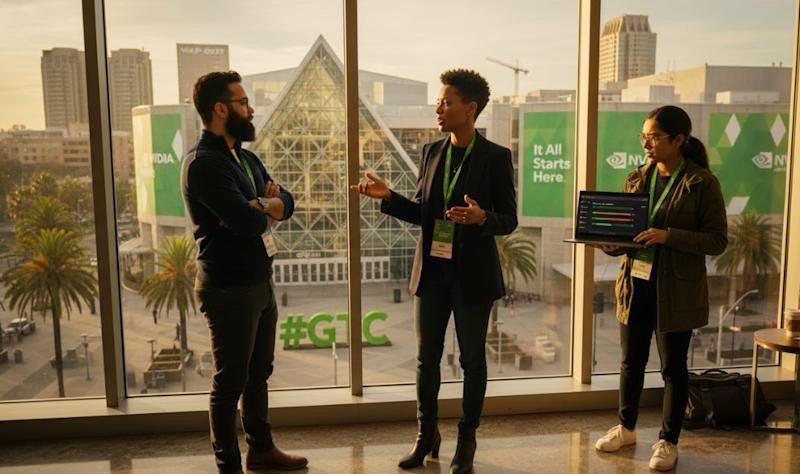
For the first time in a major AI platform release, security was built in from the start, not added as an afterthought. At Nvidia GTC this week, five cybersecurity vendors announced protections for Nvidia’s agentic AI stack, with four already deployed and one in early-stage validation. This rapid response reflects the accelerating threat landscape: nearly half (48%) of cybersecurity professionals now rank agentic AI as the top attack vector by 2026, yet just under a third (29%) of organizations feel fully prepared to deploy these technologies securely.
The stakes are high because machine identities now outnumber human employees by an overwhelming 82 to 1 in the average enterprise. IBM’s 2026 X-Force Threat Intelligence Index shows a 44% increase in attacks exploiting public-facing applications, fueled by AI-enhanced vulnerability scanning. Nvidia CEO Jensen Huang bluntly stated at GTC: “Agentic systems accessing sensitive data, executing code, and communicating externally? That cannot be allowed.”
The First Integrated Security Stack
Nvidia designed a flexible threat model to accommodate five vendors. Google, Microsoft Security, and TrendAI are collaborators on Nvidia’s OpenShell platform. This analysis maps the commitments from the GTC announcements, not Nvidia’s official specifications.
No single vendor covers all five governance layers. CrowdStrike excels in agent decision-making and identity, Palo Alto Networks focuses on cloud runtime, JFrog handles supply chain provenance, Cisco inspects prompts, and WWT provides pre-production validation. The audit matrix below reveals where gaps remain. Three or more unanswered vendor questions mean ungoverned agents are running in production.
The Five-Layer Governance Framework
This framework draws from vendor announcements and the OWASP Agentic Top 10. Each layer requires specific vendor assurances. If a vendor cannot answer, that layer remains ungoverned.
The audit matrix shows which vendors cover which layers. Three or more unanswered questions indicate significant governance risks.
Vendor Capabilities in Detail
CrowdStrike’s Falcon platform integrates at four points in the Nvidia OpenShell runtime: AIDR at the prompt-response-action layer, Falcon Endpoint on DGX hosts, Falcon Cloud Security for AI-Q deployments, and Falcon Identity for agent privilege boundaries. Palo Alto Networks enforces at the BlueField DPU hardware layer within Nvidia’s validated AI Factory design. JFrog governs the artifact supply chain from registry to signing. WWT validates the full stack pre-production. Cisco provides independent guardrails at the prompt layer.
CrowdStrike and Nvidia are also building “intent-aware controls.” This distinction matters: constrained agent access is different from monitoring its planning loop for behavioral drift. The gap between these approaches is where the 4% error rate at 5x speed becomes dangerous.
Why Blast Radius Has Changed
Daniel Bernard, CrowdStrike’s chief business officer, explained to VentureBeat how a compromised AI agent differs from a human attacker. “Anything we thought about before in terms of blast radius is unbounded,” Bernard said. “A human attacker needs to sleep. In the agentic world, there’s no such thing as a workday.”
An AI agent operates at compute speed across every API, database, and downstream agent it can reach—without fatigue or shift changes. CrowdStrike’s 2026 Global Threat Report shows the fastest observed eCrime breakout in 27 seconds, with average times at 29 minutes. An agentic adversary doesn’t have an average; it runs until stopped.
When asked about the 96% accuracy number, Bernard was blunt: “Having the right kill switches is essential to quickly correct errors.” A 4% error rate at 5x speed means mistakes arrive five times faster. SOCs must adapt to this speed.
Bernard’s broader message: “Enterprises need to transform their SOCs from history museums into autonomous fighting machines.” Most are not prepared.
The Full Vendor Stack
Each vendor occupies a unique enforcement point. Cisco’s Secure AI Factory extends Hybrid Mesh Firewall enforcement to Nvidia BlueField DPUs, adding AI Defense guardrails to OpenShell runtime. Palo Alto Networks runs Prisma AIRS on BlueField DPUs, offloading inspection to the hardware layer. JFrog’s Agent Skills Registry provides a system of record for models and skills within Nvidia’s AI-Q architecture, with full OpenShell support in development. WWT launched a Securing AI Lab inside its Advanced Technology Center, built on Nvidia AI factories and the Falcon platform, for pre-production validation.
Key Gaps Remain
Despite progress, three critical governance gaps remain: agent-to-agent trust, memory integrity, and registry-to-runtime provenance. No vendor at GTC closed these.
Agent-to-agent trust requires solving credential compounding. Independent research from BlueRock Security found 36.7% of MCP servers contain vulnerabilities. Memory integrity demands protecting against poisoning an agent’s long-term memory. Registry-to-runtime provenance requires cryptographic verification of artifacts from registry to execution.
Running five vendors also introduces operational overhead. Someone must orchestrate policies, normalize telemetry, and manage change control. A realistic rollout starts with the supply chain layer (JFrog), then identity governance (CrowdStrike), followed by runtime instrumentation (Falcon AIDR or Cisco AI Defense).
The takeaway: organizations must audit every autonomous agent against these five layers, identify gaps, and hold vendors accountable. The architectural scaffolding is now in place. The real work begins now.