I expected slop.
You know the type. Midjourney hallucinations. AI video clips that warp and melt into incoherent digital noise. The internet is flooded with it, and rightfully so, people are tired. We are skeptical of the machine mimicking human creativity. So walking into Dataland, the world’s first AI museum in Los Angeles, I was braced for a lecture on why I was wrong. I was also braced to hate it.
Refik Anadol did not give me what I expected. He gave me a kaleidoscope.
Anadol, a Turkish programmer and artist, has been playing with this for a decade. His claim is simple. Data is his paint. The algorithms are his brushes. The museum isn’t about replacing the human hand; it’s about translating information into something you can feel. Can artwork feel us back? he asks. Can data have emotions?
Let’s look at the space before we judge the medium.
The Rainforest in a Black Box
The museum is tucked inside Grand LA. It’s an artful office park with spiral staircases that look like they were pulled from a sci-fi movie, staring down the Frank Gehry curve of the Walt Disney Concert hall.
Inside, the debut exhibit, Machine Dreams: Rainforests, unfolds across five windowless rooms. The floors are black mirrors. The walls are light. The air smells like earth. Or at least, it tries to.
You start with an intake. You get two devices. A wristband. A scent emitter hanging around your neck.
The wristband tracks your heart rate, skin temp, location. The emitter releases subtle smells based on where you stand. It wasn’t overpowering. Thank goodness for that. Smells are hard. Bad smells ruin everything.
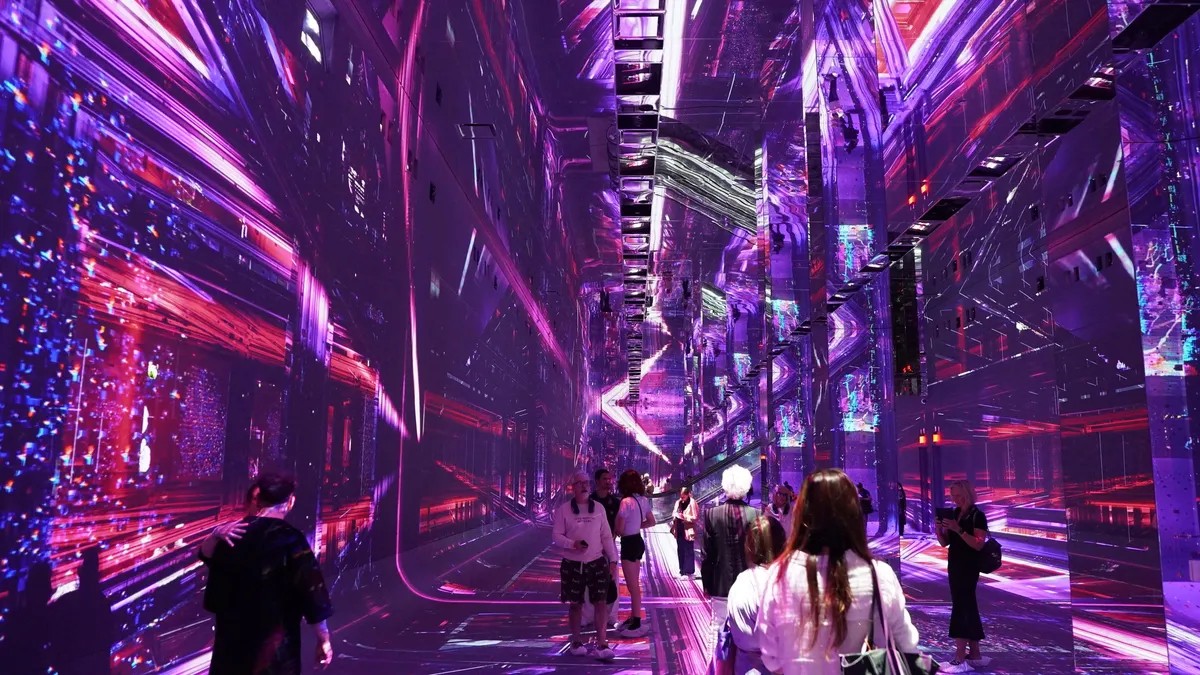
Then you drop into the Data Pavilion. This is the centerpiece. Screens go thirty feet high. Projectors paint the floor. It feels like walking into the inside of a supercomputer. Not the cold kind. The warm kind. Where the code has dreams.
Anadol calls his AI the Large Nature Model. It’s not some generic model trained on all of Pinterest. It’s built specifically on images from sixteen rainforests across the globe. He calls it ethical data. It comes from the Smithsonian. Licensed. Clean. Or as clean as data gets.
Watching the Watchers
Here is the trick. You think you are watching a screensaver.
But the room is watching you back.
Lidar scanners in the ceiling track your position. Your heart rate feeds the rhythm. If you stop moving, the light vines on the wall slow down. Fireflies swirl around your ankles when you pause.
“So when we enter,” Anadol explains, “the whole gallery is sensing our heartbeats. Our emotions.”
Did I notice it changing because of me? Not really.
It was too beautiful to be critical. The visuals pulsed. Colors shifted from abstract orbs to digital trees. It felt like The Van Gogh Experience had a child with a GPU server rack. High fidelity. High speed. Aesthetic bliss.
But where is the data? Where is the insight?
There was a wall of dots. Each dot a piece of information. A constellation of facts made pretty. I stared at it for ten seconds. I saw the pretty dots. I didn’t see the Amazon basin drying up. I didn’t see soil health. I just saw pretty dots.
“There is no text here. No prompting. The emotions of the visitors create the art.”
Can You Eat the Algorithm?
Art can be immersive. It can be multisensory. It doesn’t always have to be smart.
But Dataland wants to be more than a theme park for your eyes. They tried. Hard.
There was a hall of chocolates.
Yes. Chocolates.
A local chef used rainforest data to craft flavors. Soil types became truffle bases. Animal movements inspired swirls. I ate one flavored like fungal floors. It was mushroom. It tasted like a forest after rain.
It worked. For a minute. The abstraction broke down. Taste is primal. Data is cold. Connecting the two is… interesting. It’s also weird. I wanted a graph. I got a bonbon.
Which raises the question. What do we take home from an AI museum? Not just merch. Understanding.
In the final room, the AI Sanctuary, I saw my results.
An “emotion score.”
My data. Summarized into a swirl of light. I scored lower on excitement than most. (I’m a cynic. It showed.) The room then displayed my data as an abstract painting. My anxiety. My calm. Turned into blue and orange waves.
It looked nice. Did I understand it?
I’m not sure. Without a clear legend, without a link between my heart rate spike and a specific shift in hue, it remained abstract. A painting of myself? Maybe. A visualization of data? Technically, yes. A revelation? Debatable.
You can print your data on a coaster or a shirt. Otherwise, it deletes itself. No tracking. Good privacy practice. A rare gem in 2024.
The Machine Behind the Curtain
Let’s talk about the iron.
Dataland isn’t running on a laptop. It’s running on 150 Nvidia RTX 6000 industrial-grade graphics cards. Each card costs around $13,000. That’s over a million dollars in compute power humming behind the velvet ropes.
The Large Nature Model runs on Google servers in Oregon. Sustainable energy.
Anadol isn’t hiding the tech. He’s showcasing the scale.
“Sure, we have AI,” he said. “But it is a human-machine collaboration. We are experimenting.”
He sees the hype cycle. He hears the paranoia. He knows why gamers are mad and why actors are striking. The fear is valid. The art generated by text-to-image bots can be lazy. Uninspired. Theft wearing a digital mask.
Anadol rejects that. His work isn’t generated by typing “make me a cool tree.”
It is fed millions of images of actual trees. Processed through custom algorithms. Designed to be immersive.
The line is thin.
But here it stands. A permanent home for this kind of work. Rotating exhibits every year. Each one a new experiment.
Is Dataland a necessary destination? For a casual viewer? Probably not.
Is it a fascinating glimpse into how we might live with machine intelligence?
Yes.
We are going to produce data. We will consume it. We will live in it.
Maybe we just needed to learn how to smell it.
I left thinking about the chocolate. Not the dots. The flavor was clearer. More human.
Perhaps the best AI art is the kind that helps us remember we are flesh. That we breathe. That we sweat. That our heart rate matters.
If nothing else, Anadol proved that data can have a heartbeat.
If it can, what else might it do?
That depends. Are we paying attention?