


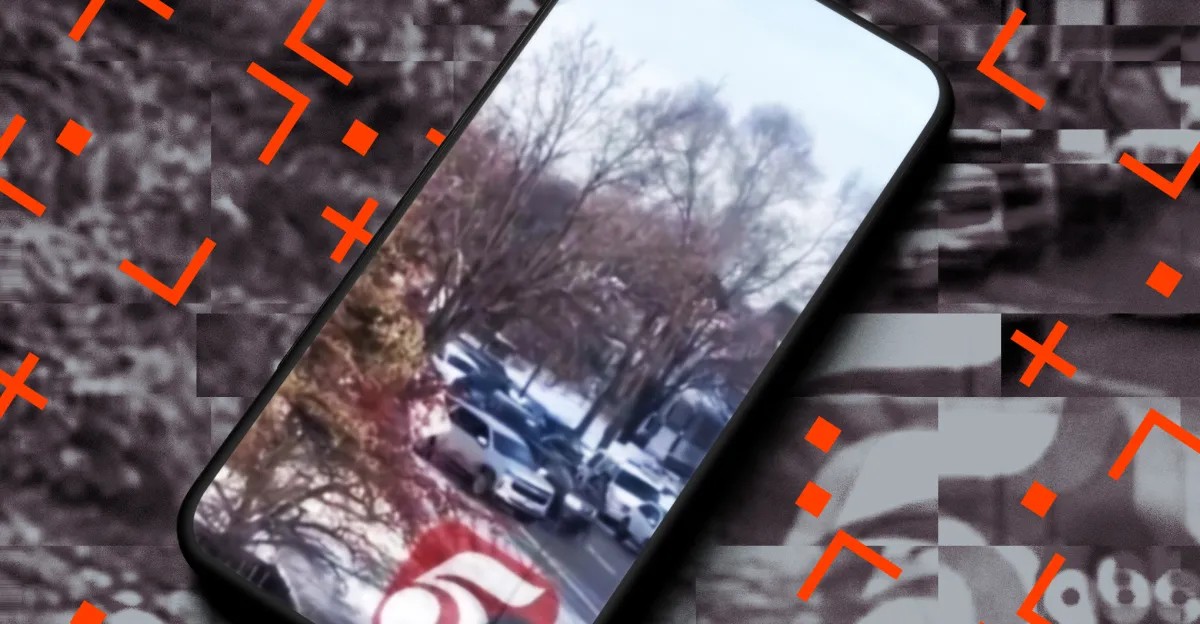
A widely circulated video depicting the fatal shooting of Renee Good, 37, by an Immigration and Customs Enforcement (ICE) agent in Minneapolis has become a focal point in hyper-partisan media and political messaging. The incident, which occurred shortly after federal officials deployed agents to Minnesota following unverified claims of welfare fraud, has been framed by right-wing figures as an act of “domestic terrorism” by Good.
The Contested Narrative
The core of the controversy revolves around a grainy, low-quality clip shared by Donald Trump on Truth Social. The video, seemingly captured from an elevated position with obstructed views, shows the moments leading up to the shooting. Trump and other conservative voices claim Good “violently” attempted to run over the ICE agent, framing the shooting as self-defense. However, multiple videos from different angles contradict this narrative.
Witness footage shows ICE agents approaching Good’s vehicle, one visibly attempting to open her door and ordering her to exit. The agent fired three shots into the car before Good accelerated, according to a New York Times analysis of the footage. The agent appears to film Good on his phone before firing his weapon.
The Spread of Misinformation
Despite mounting contradictory evidence, the low-quality clip has gained traction as “incontrovertible proof” for far-right audiences. Megyn Kelly shared the video repeatedly on X, while the Libs of TikTok account amplified it with inflammatory rhetoric. The clip’s virality underscores a broader trend: in an era saturated with misinformation, even blurry and heavily edited footage can serve as fuel for propaganda.
The incident has also spurred attempts to “unmask” the ICE agent using AI tools, with some users on X attempting to use Elon Musk’s Grok chatbot to identify him. These efforts, combined with the circulation of fake AI-generated images, highlight the growing role of generative AI in exacerbating distrust and confusion.
Echoes of George Floyd
The controversy evokes parallels to the 2020 killing of George Floyd, captured on a bystander’s cellphone and triggering widespread protests. Yet, unlike the clear and graphic footage of Floyd’s death, the Good shooting is framed through deliberately obscured and manipulated imagery. This difference points to a key shift: the weaponization of low-quality, selectively edited footage to enforce preferred narratives rather than expose truth.
The incident is not about clarifying facts; it’s about leveraging ambiguity to reinforce pre-existing biases.
The Trump administration’s insistence on the blurry video as evidence, despite its flaws, exemplifies this dynamic. The incident serves as a stark illustration of how easily visual media can be distorted to fit political agendas, eroding the already fragile foundations of shared reality.


