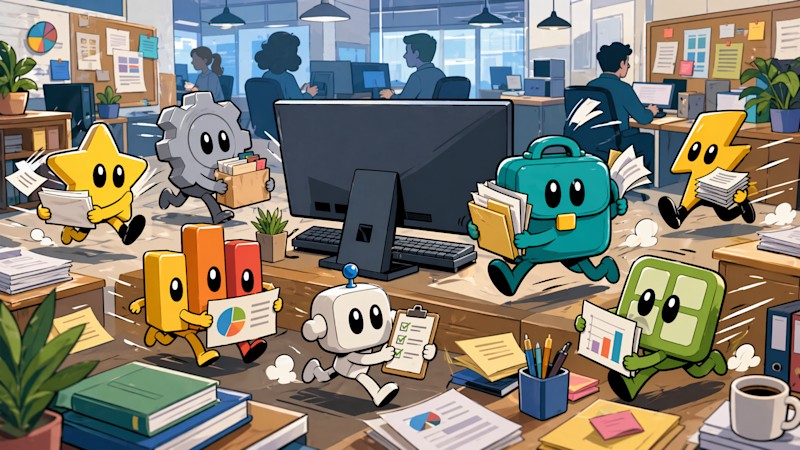
OpenAI has officially signaled a major shift in its product strategy, moving away from simple conversational AI toward a fleet of autonomous “digital coworkers.” With the launch of Workspace Agents, the company is transitioning from tools that merely answer questions to agents that actively execute complex business processes across various software ecosystems.
The Evolution: Beyond Custom GPTs
For much of the past year, businesses have used “Custom GPTs”—specialized versions of ChatGPT designed for specific tasks. However, these were largely session-based, meaning they required a human to initiate every interaction.
Workspace Agents represent a fundamental upgrade:
– Integration: They plug directly into enterprise tools like Slack, Salesforce, Google Drive, Microsoft 365, Notion, and Atlassian.
– Autonomy: Unlike previous models, these agents can run on schedules, perform multi-step tasks, and continue working even after a user has logged off.
– Persistence: Powered by the Codex cloud-based engine, these agents possess “memory.” They learn from corrections and adapt to a team’s specific workflows and standards over time.
This marks the end of “babysitting” AI. Instead of a human prompting a bot for every single step, these agents are designed to “go off and get work done” within defined business boundaries.
The Technical Backbone: Why This Matters
The most critical distinction for enterprise buyers is the underlying architecture. While previous AI interactions were primarily “call-and-response” loops (user asks, AI answers), Workspace Agents operate on a code-execution substrate.
By using Codex, an agent doesn’t just describe how to reconcile a spreadsheet or generate a report; it actually writes and runs the necessary code to fetch data, transform it, and render accurate charts. This move from “talking about work” to “executing work” is what differentiates a sophisticated assistant from a simple chatbot.
Managing a Digital Workforce: Governance and Security
As AI agents gain the power to send emails, edit spreadsheets, and post to Slack, the risks of autonomy increase. OpenAI has addressed this through a robust governance framework:
- Granular Permissions: Administrators can control who can build, run, or publish agents.
- Human-in-the-Loop: By default, “write actions” (like sending a message or filing a ticket) require human approval.
- Authentication Models: Companies can choose between end-user mode (the agent only sees what the specific user sees) or agent-owned mode (using a shared service account for seamless automation).
- Compliance: A new Compliance API allows admins to audit every configuration and run history, ensuring transparency in how the “digital workforce” is operating.
The Competitive Landscape
OpenAI is not alone in this race. This launch places them in direct competition with several heavyweights:
– Microsoft Copilot Studio (deeply integrated into Office 365)
– Salesforce Agentforce (focused on CRM automation)
– Google Agentspace
– Anthropic’s Claude Managed Agents
However, OpenAI’s advantage lies in its rapid integration of the Codex ecosystem, turning ChatGPT from a standalone destination into an invisible layer of intelligence that lives inside the apps employees already use.
Looking Ahead
The transition will not be instantaneous, but it is definitive. OpenAI has indicated it will eventually deprecate the custom GPT standard for organizations, requiring users to migrate to Workspace Agents.
For early adopters like the HR platform Rippling, the impact is already visible. They report that sales agents can now research accounts and summarize calls automatically—tasks that previously consumed hours of manual labor each week.
Conclusion: OpenAI is pivotally shifting the AI paradigm from individual productivity tools to shared organizational resources. By replacing static chat interfaces with autonomous, permissioned agents, they are attempting to transform AI from a novelty into a foundational component of the modern enterprise workflow.