The dream of a robot that can fold your laundry, organize your desk, or even handle delicate paper money is moving from science fiction toward reality. While previous generations of robotics struggled with the unpredictability of the physical world, a new breakthrough in Physical AI is bridging the gap between rigid programming and human-like dexterity.
The Gen-1 Breakthrough
California-based Generalist AI has unveiled Gen-1, a new physical AI model designed to serve as a universal “brain” for various robotic systems. Unlike traditional models that might only work for a specific industrial arm, Gen-1 is built to be platform-agnostic, meaning it can power everything from a humanoid robot to a stationary industrial limb.
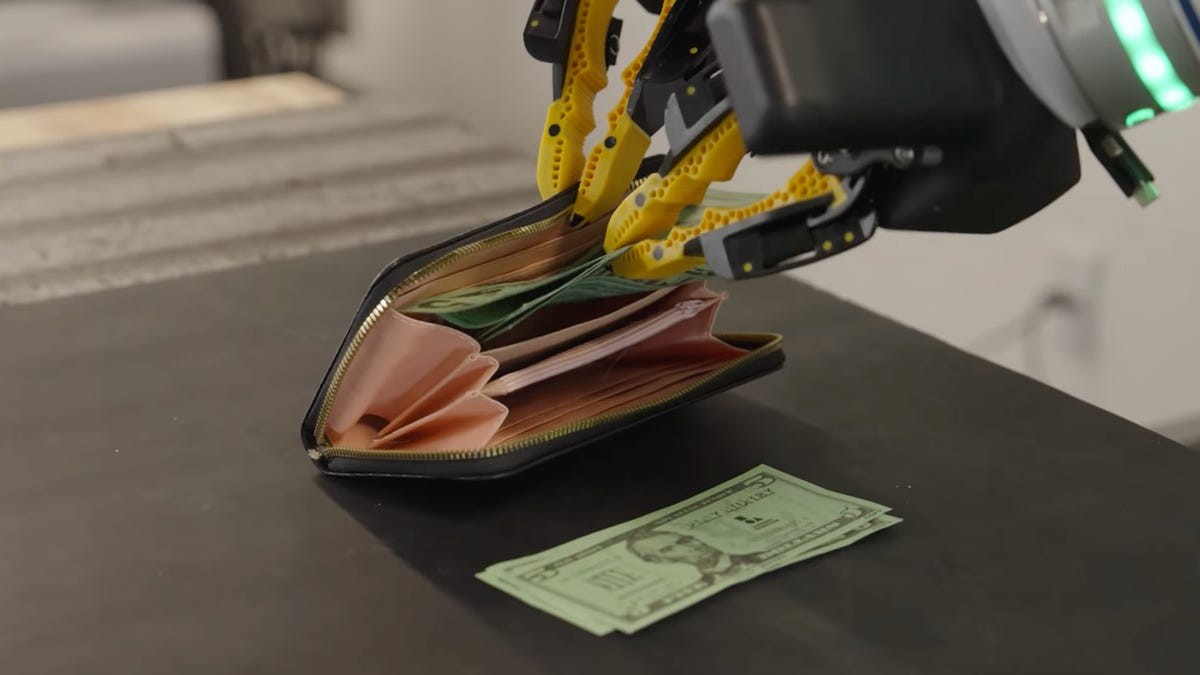
The model’s capabilities are best demonstrated through its ability to handle “fiddly” tasks—actions that require fine motor skills and an understanding of texture and friction. Recent demonstrations include:
– Handling currency: Successfully withdrawing and reinserting flimsy paper money into a wallet.
– Household chores: Sorting socks by color and folding them into neat piles.
– Precision tasks: Unzipping pencil cases, stacking oranges in pyramids, and plugging in Ethernet cables.
Solving the Data Problem: “Data Hands”
To understand why this is a leap forward, one must look at the primary hurdle in robotics: data scarcity.
While Large Language Models (like ChatGPT) were trained on the vast expanse of the internet, robots lack a similar “internet of physical movement.” Most robots are trained through teleoperation, where a human remotely controls a robot to teach it a task. This is slow and difficult to scale.
Generalist AI bypassed this bottleneck by using a more organic approach. They distributed wearable technology to humans globally, allowing them to perform millions of tasks. This provided the AI with “data hands”—a massive dataset capturing the subtle nuances of human movement, such as:
* Tactile feedback: How much pressure to apply to an object.
* Slip and recovery: How to adjust a grip when an object begins to slide.
* Force modulation: The ability to distinguish between a soft sock and a hard smartphone.
This data allows the robot to develop “physical common sense,” moving away from executing rigid, pre-set instructions and toward an intuitive understanding of how objects behave.
From Rigid Programming to Robotic Improvisation
One of the most significant shifts highlighted by Gen-1 is the move toward improvisation.
Traditionally, if a robot encountered a slight change in its environment—such as a part being placed slightly out of reach—it would simply fail. Gen-1 is designed to “think on its feet.” For example, in an automotive assembly task, the model demonstrated the ability to use two hands to reposition a part, despite having only been trained to use one. This ability to adapt to “curveballs” is essential for robots to transition from controlled factory floors to the chaotic environments of retail, hospitality, and eventually, our homes.
The Economic Horizon
The timing of this advancement aligns with a massive shift in the global economy. As companies like Boston Dynamics and Honor push the boundaries of humanoid movement, analysts see a burgeoning market. Morgan Stanley predicts the robotics market could reach $5 trillion by 2050.
For this market to realize its potential, robots must move beyond heavy lifting and into the realm of complex, everyday interactions. The success rates seen in Gen-1—such as increasing the success rate of servicing a robot vacuum from 50% to 99%—suggest that the transition from industrial tools to household helpers is accelerating.
“We are beginning to see real progress and are excited to push the boundaries of embodied intelligence.” — Pete Florence, Co-founder and CEO of Generalist AI
Conclusion
By training AI on the subtle nuances of human touch rather than just rigid commands, Generalist AI is moving robotics closer to true autonomy. This shift from programmed repetition to physical improvisation is the key to bringing useful, reliable robots into our homes and workplaces.