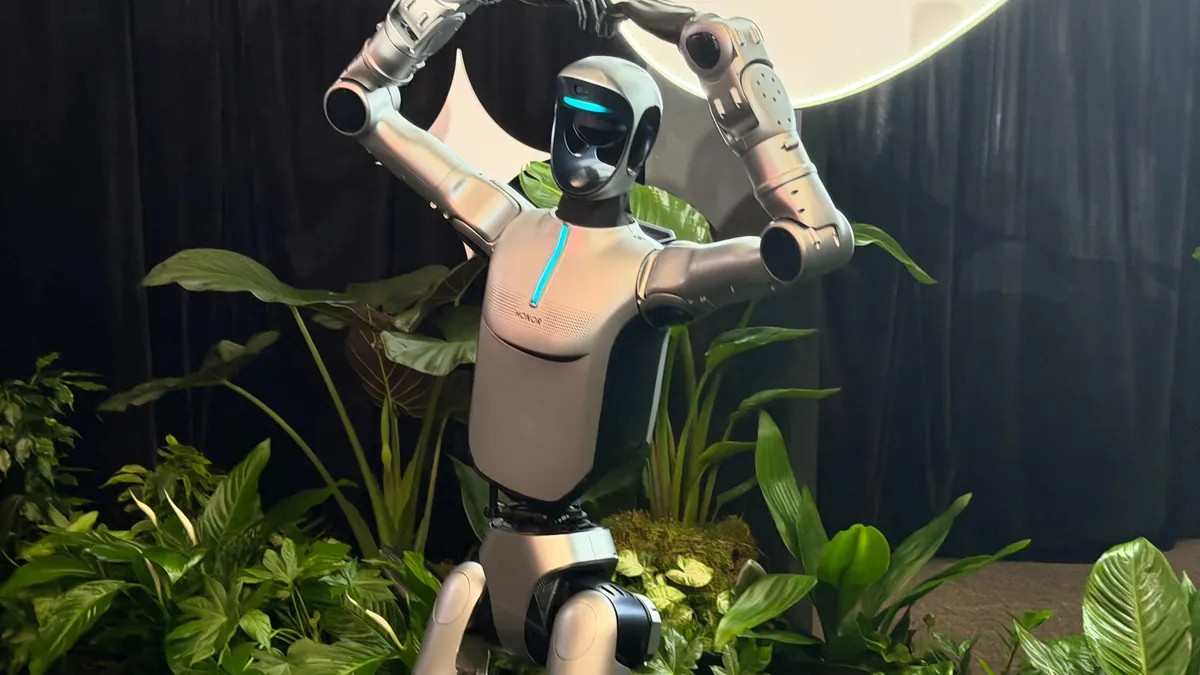
Honor, a leading smartphone manufacturer, stunned attendees at Mobile World Congress (MWC) in Barcelona on Sunday by unveiling its first fully functional humanoid robot. The demonstration, set to Imagine Dragons’ “Believer,” featured the robot performing a choreographed dance including a moonwalk and attempted backflip – marking the first time a major phone-maker has entered the humanoid robotics arena.
A Bold Leap into Robotics
This move positions Honor uniquely among its Android competitors, who have largely focused on software and mobile hardware. Unlike many robotics firms that begin with industrial applications, Honor is explicitly designing its robots for consumer use. The company previously announced its robotics ambitions in October, showcasing a non-functional prototype at CES in January before this week’s live demonstration of the “Robot Phone” with an articulated camera arm.
Planned Use Cases
Honor plans to deploy these robots across three core applications:
- Shopping Assistance: Providing hands-on support in retail environments.
- Workplace Inspections: Assisting with physical assessments in industrial settings.
- Supportive Companionship: Offering assistance and companionship to users.
The robot’s slightly unstable backflip attempt underscored that this technology remains in early stages, but the fact that it recovered with an outstretched hand highlights its agility and responsive design.
AI Investment Drives Expansion
This robotics push is backed by Honor’s previously announced $10 billion investment in artificial intelligence (AI). CEO James Li explained that the company’s vision extends beyond software, aiming to integrate AI into the physical world. According to Li, “If the smartphone is an extension of our minds, the robot would be an extension of our hands.”
Industry Trend
Honor’s entry into consumer robotics is part of a growing trend seen at CES earlier this year, where multiple companies showcased humanoids designed for integration into daily life. This suggests a near-future where robots are no longer limited to factories but will become commonplace assistants in homes, offices, and public spaces.
The robot’s debut signals not only Honor’s ambition but also a shift in the broader tech landscape, where AI-powered robotics is rapidly moving from concept to consumer reality.