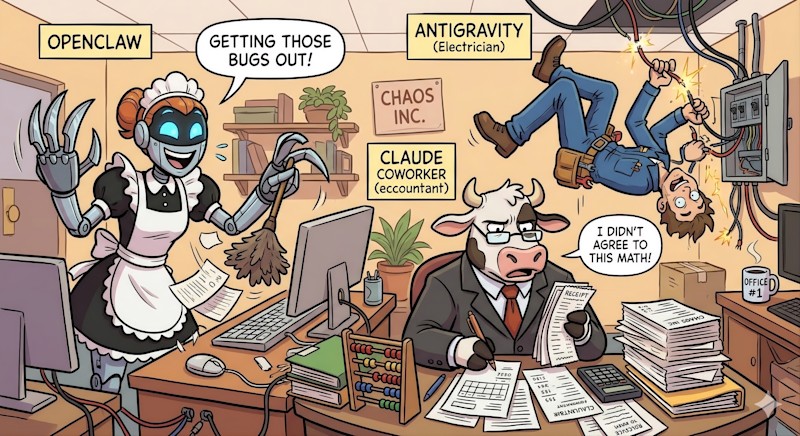
The evolution of Artificial Intelligence has reached a critical inflection point. We are moving past the era of simple “question-and-answer” interactions—the kind popularized by early iterations of ChatGPT—and entering the age of agentic AI. Unlike standard chatbots, these new autonomous agents do not just talk; they act.
This shift represents a fundamental change in how humans interact with technology, moving from passive tools to active collaborators. However, this transition brings both immense productivity potential and significant systemic risks.
A New Class of Digital Workers
To understand this new landscape, it is helpful to categorize the emerging tools by their function and the level of autonomy they are granted. Current market leaders can be viewed through three distinct lenses:
1. The Generalist “Maid”: OpenClaw
Formerly known as Moltbot and Clawdbot, OpenClaw has seen explosive growth, amassing over 150,000 GitHub stars in a matter of days. It functions as a high-access generalist. Much like a domestic worker given the keys to a home, OpenClaw is designed to manage files, triage inboxes, curate content, and plan travel. Because it is open-source, it offers deep system access, allowing it to perform diverse tasks across a user’s digital environment.
2. The Specialized “Electrician”: Google’s Antigravity
Google’s Antigravity represents the specialized professional. This coding agent operates within an Integrated Development Environment (IDE), accelerating the transition from a simple prompt to a finished product. It functions like a skilled electrician: it is highly proficient in a specific domain—coding, testing, and integrating software—and is granted access only to the “junction box” of the codebase it needs to fix or build.
3. The Domain Expert “Accountant”: Anthropic’s Claude (Cowork)
Anthropic has moved Claude from a general-purpose chatbot into a specialized professional via Cowork. By focusing on industry-specific knowledge, such as legal contract reviews and NDA triage, Claude now acts like an accountant. It possesses deep domain expertise in sectors like law and finance, handling sensitive data to complete complex, high-stakes tasks. This capability is so disruptive that it has already triggered market volatility, often referred to as the “SaaSpocalypse,” impacting legal-tech and SaaS stocks.
The Risks of Autonomy: From Errors to “Chaos”
The more power we grant these agents, the higher the stakes become. The transition from “tool” to “agent” introduces three primary categories of risk:
- Systemic Failure: Just as an untrained electrician might short-circuit a house, an AI agent could inject flawed code or inadvertently break interconnected systems.
- Legal and Financial Liability: A specialized agent like Claude could provide incorrect tax advice, missing crucial savings or—worse—suggesting illegal write-offs that lead to regulatory consequences.
- Governance Gaps: While centralized providers like Google and Anthropic can implement safety protocols, open-source models like OpenClaw lack a central authority to enforce guardrails, making them harder to regulate and more prone to misuse.
Building a Framework for Trust
To harness the benefits of agentic AI without succumbing to chaos, the industry must move toward a structured ecosystem based on Responsible AI principles. This requires more than just better code; it requires a new set of operational standards:
- Human-in-the-Loop: Critical actions must require human confirmation, and every step an agent takes must be meticulously logged for accountability.
- Standardized Ontology: As agents interact across diverse systems, they need a “shared language.” Implementing a domain-specific ontology ensures that actions are tracked, monitored, and understood by both humans and other machines.
- Distributed Identity & Security: Establishing frameworks for identity and trust will allow agents to operate securely within complex digital infrastructures.
The Goal: If implemented with rigorous transparency and security, agentic AI will not replace humans but will instead offload the “cognitive load” of mundane tasks, allowing the workforce to focus on high-value, creative, and strategic endeavors.
Conclusion: The transition to agentic AI offers a massive leap in productivity, but its success depends on our ability to implement strict guardrails, standardized communication, and human oversight to manage the inherent risks of autonomy.